A Complete Guide for Solar Installers in Pakistan
Are you looking to set up a solar panel system in Pakistan? Then you need to know what the distinction between net metering and net billing is. Both systems are used in allowing the return of excess solar power to the grid; however, the two systems function in different ways and there can be major implications on how much you pay each month on your electricity bills.
Below we will explain the two systems, compare their attributes and determine which is the best for you.
What Changed in Pakistan in 2026?
Here are the main points of NEPRA's new rules, in simple words:
| Topic | Rule since 9 February 2026 |
|---|---|
| Billing method | Net billing. Units you take from the grid are billed at the applicable tariff. Units you export are credited at the national average energy purchase price. |
| Export rate changes | NEPRA can revise the export rate during your agreement. |
| Extra credit | If your exports are worth more than your imports, the difference is carried to your next bill or paid to you quarterly. |
| Who can apply | 3-phase 400V or 11kV consumers (domestic, commercial, industrial, agricultural, general services or bulk supply). |
| System size | Solar, wind or biogas up to 1 MW, and not more than your sanctioned load. |
| Approval | Up to 25 kW: your DISCO approves it (since 6 August 2026). Above 25 kW: NEPRA concurrence is needed, with a one-time fee of Rs 1,000 per kW. |
| Agreement term | 5 years, renewable by mutual consent. |
| Old net-metering users | Keep the old rate and billing method until the agreement expires. This ends early if you make a change that alters your system's maximum output. |
Sources: NEPRA (Prosumer) Regulations, 2026 (S.R.O. 251(I)/2026, 9 Feb 2026) and amendments S.R.O. 547(I)/2026 (2 Apr 2026), S.R.O. 709(I)/2026 (28 Apr 2026, fees) and S.R.O. 1330(I)/2026 (6 Aug 2026), all on nepra.org.pk.
Quick Summary
| Net Metering | Net Billing |
|---|---|
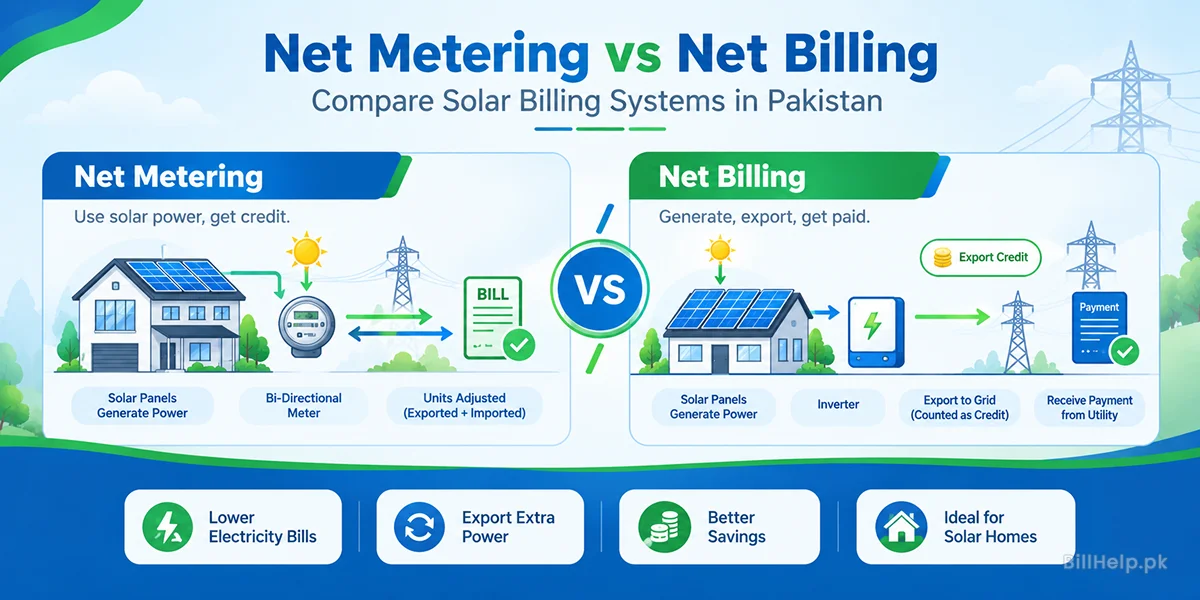
| Excess electricity is adjusted against the electricity you consume from the grid. | Excess electricity is purchased separately by the electricity company at a set rate (in Pakistan, the national average energy purchase price). |
| Directly reduces your monthly electricity bill. | Your electricity bill is calculated separately and you are paid or credited for the electricity you export. |
| Usually provides higher savings. | Savings depend on the export purchase rate. |
What Is Net Metering?
Net Metering refers to a system where the owners of a solar system get to feed their excess energy into the electricity grid. This is in exchange for the units which will be deducted against the units they import from the grid.
When it is bright, your solar panels may produce electricity in excess of what you require. This excess energy is put into the electricity grid rather than having it go to waste. When your solar panels do not produce enough electricity—for instance at night—you draw electricity from the grid and this helps you save some money on your bills.
How Does Net Metering Work?
- Solar panels produce electricity.
- Your home uses the required electricity.
- Extra electricity is exported to the national grid.
- At night or during low sunlight, electricity is imported from the grid.
- The exported units are adjusted against the imported units.
- If there are any units left you only pay for them.
For instance: if you import 600 units in one month and export 400 units, you will be charged for only 200 units (subject to applicable charges and regulations).
What is Net Billing?
Net Billing can also pay solar users for the electricity they send back to the grid. But unlike Net Metering the exported electricity is not netted off the imported electricity units.
Instead, the utility buys your exported power at a set rate and separately gives you a payment or a credit. In Pakistan, this rate is the national average energy purchase price, and NEPRA can revise it. Your imported electricity is billed normally according to the applicable tariff.
How Net Billing Works
- Solar panels produce electricity.
- Your home uses the electricity it needs.
- Extra electricity is sold to the grid.
- The units that exported will be recorded by the electricity company.
- You get paid or credited for the units that are exported.
- Your imported electricity is billed separately.
Net Metering vs Net Billing
| Feature | Net Metering | Net Billing |
|---|---|---|
| Billing Method | Exported units offset imported units | Imported and exported electricity are billed separately |
| Electricity Credit | Unit-to-unit adjustment | Payment or monetary credit |
| Monthly Bill | Usually much lower | Depends on export payment rate |
| Return on Investment | Faster | Comparatively slower |
| Savings | Higher in most cases | Moderate |
| Best For | In Pakistan: only users with an agreement signed before 9 February 2026 | In Pakistan: all new solar applicants since 9 February 2026 |
Real-Life Example
Suppose your monthly electricity usage is as follows:
| Description | Units |
|---|---|
| Electricity Imported from Grid | 600 Units |
| Electricity Exported to Grid | 400 Units |
Under Net Metering
| Imported Units | 600 |
| Exported Units | 400 |
| Units Adjusted | 400 |
| Billable Units | 200 |
Under Net Billing
| Imported Units | 600 |
| Exported Units | 400 |
| Electricity Bill | Charged for 600 Units |
| Export Payment | Separate payment or credit |
This example shows why Net Metering usually provides greater savings for residential consumers.
Net Metering Pros
- Cuts down electricity bills per month.
- Better return on investment.
- Uses excess solar energy.
- Faster cost reduction for solar installations.
- Environment friendly.
- Great for home or office use.
Net Metering Cons
- Needs to be approved by the electricity company.
- Bi-directional meter must be approved.
- Please note approval can take some time.
- In Pakistan, closed to new applicants since 9 February 2026.
Advantages of Net Billing
- Simple billing process.
- Payment for export of electricity separately.
- Encourages solar energy production.
- Suitable for certain billing policies.
Disadvantages of Net Billing
- Imported electricity is billed normally.
- Export rates may be lower than electricity purchase rates.
- Lower monthly savings compared to Net Metering.
- Longer payback period for the solar investment.
Between the Two Which is Best?
On paper, net metering saves more because exported units are adjusted against imported units. But in Pakistan you can no longer choose it for a new system. Since 9 February 2026, every new solar connection comes under net billing.
If you already have a net-metering agreement, keep it. You will be billed under the old method until it expires. Avoid changes that alter your system's maximum output, because that ends the old terms early. If you are installing solar now, plan for net billing: size your system to use as much of your solar power as you can during the day.
Things to Keep in Mind Before Making a Choice
Consider these factors before choosing your solar system installation:
| Factor | Why It Matters |
|---|---|
| Monthly Electricity Usage | Helps determine the right solar system size. |
| Daytime Electricity Consumption | Affects how much electricity is exported. |
| Night time use of electricity | Determines the amount of electricity imported. |
| Size of the Solar System | Affects the total amount of electricity generated. |
| Electricity Tariff | Impacts potential savings. |
| Government Policies | Rules changed in 2026, and NEPRA can revise the export rate during your agreement. |
| Budget | Helps select the most suitable system. |
Frequently Asked Questions
Which is better – Net Metering or Net Billing?
On paper, Net Metering is more cost-effective because exported units directly offset the units you take from the grid. In Pakistan, however, it is closed to new applicants since 9 February 2026. New systems come under Net Billing, while older agreements keep their terms until they expire.
Can I earn money through Net Metering?
Net Metering mainly reduces your electricity bill by adjusting exported units against imported units. It is not generally designed as a source of direct income.
Does Net Billing reduce my electricity bill?
With Net Billing, you will be paid or credited for your exported energy, but your imported energy is charged separately.
Which is faster in generating returns on investments?
Normally, Net Metering provides faster returns since it generates more savings in monthly bills.
Is there any possibility that the criteria can change?
Yes, and they already have. NEPRA moved new solar users from net metering to net billing on 9 February 2026, and amended the rules again in April and August 2026. NEPRA can also revise the export rate during your agreement.
Will my existing net-metering agreement change?
No, not until it expires. Under S.R.O. 547(I)/2026, an agreement signed under the old rules keeps its rate and billing method until the end of its term. This protection ends if you make a material change that alters your system's maximum output.
Can a single-phase connection get net billing?
No. NEPRA's 2026 regulations define an applicant as a 3-phase 400V or 11kV consumer. Single-phase consumers need to upgrade to 3-phase first.
Both Net Metering and Net Billing can assist solar owners in optimizing their solar energy usage. However, both schemes differ on the way excess energy is reimbursed. In the case of Net Metering, there will be adjustments made on the electricity exported against the amount of electricity used by you, while Net Billing allows you to get paid for electricity that is exported.
In Pakistan, the choice is now made for you: existing net-metering users keep their terms until their agreement ends, and new solar users get net billing. To get the most from net billing, compare your electricity consumption with your solar production and use more of your own solar power during the day.