When you get your electricity bill in Pakistan, the total amount is not just dependent on the units you consume. There are various charges in your electricity bill and fixed monthly charges are one of them.
The consumers often find it difficult to understand the reason behind this charge as they are paying an extra amount irrespective of their consumption level. The charges are not calculated as per your units but due to your active electricity connections.
NEPRA has changed its electricity tariff structure and implemented a revision in fixed monthly charges for 2026 for various consumer categories. This was done in order to ensure better cost recovery in electricity distribution and to maintain a fair tariff structure.
In this guide, we’ll see the details of the fixed monthly charges and how they can affect your monthly electricity bill.
What Are Monthly Fixed Charges?
Fixed monthly charges are a fixed amount that will be added to your electricity bill every month. They do not change irrespective of the number of electricity units you consume.
For instance, your energy charges depend on the number of units consumed. The more units you use, the greater your energy bill. But fixed charges are different, because they’re tied to keeping your electricity service.
They assist electricity distribution companies in managing the costs associated with the provision of services such as:
- Keeping the electricity transmission and distribution systems running
- Metering and billing services
- Offering facilities for customer care
- Maintenance and Repair of Power Infrastructure
- Covering the operational costs
Although your monthly power consumption may be small, fixed charges could be imposed on your bill, depending on your consumer category and the tariff type.
Why Fixed Charges in 2026?
In order to provide reliable electricity services, Pakistan's electricity industry needs constant maintenance and upgrading. Transmission of electricity requires extensive networks, such as thousands of kilometers of transmission lines, transformers, meters and other devices that need to be maintained.
The cost involved in maintaining this network is not contingent upon the amount of electricity used by the consumer. Regardless of the number of units being used, even a customer who consumes fewer units will need the same kind of maintenance.
Therefore, NEPRA introduced changes in the tariff policy and fixed charges for different consumers in 2026.
The reasons for the changes were as follows:
- Enhancing the financial health of electricity distribution companies
- Re-capture infrastructure or maintenance costs required
- Developing a more fair power tariff structure
- Bridge the gap between electricity costs and revenue collection
This means that some consumers may see fixed charges on their bills or changes to what they used to pay
Monthly Fixed Charges of Residential Consumers
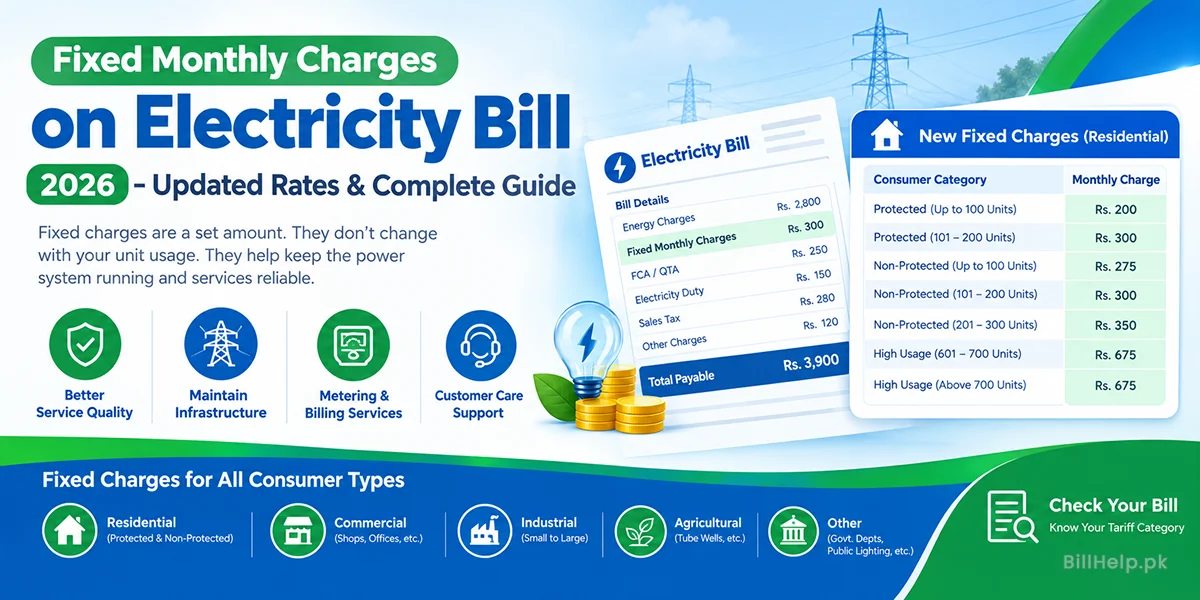
The fixed monthly charges are based on your electricity consumption and consumer type. Here are the new residential fixed charges under the 2026 tariff structure:
| Residential Consumer Category | Fixed Monthly Charges |
|---|---|
| Protected Consumers (Up to 100 Units) | Rs. 200 |
| Protected Consumers (101–200 Units) | Rs. 300 |
| Non-Protected Consumers (Up to 100 Units) | Rs. 275 |
| Non-Protected Consumers (101–200 Units) | Rs. 300 |
| Non-Protected Consumers (201–300 Units) | Rs. 350 |
| Residential Consumers (601–700 Units) | Rs. 675 |
| Residential Consumers (Above 700 Units) | Rs. 675 |
Fixed charges that apply to your electricity bill depend on tariff classification and monthly usage of electricity.
It is very important for you to know that there are various types of customers like protected and non-protected customers. There are different tariffs for each classification and there are different charges applicable.
Commercial, industrial, agricultural and other consumers have fixed charges as per their sanctioned load, connection type and tariff classification.
Residential Consumer Fixed Charges
Residential consumers make up the largest number of electricity users in Pakistan. In 2026, fixed monthly charges were revised for different residential consumption categories.
Protected Consumers
Protected consumers are households that fall under the protected category based on their electricity usage.
Such consumers normally have less energy use and enjoy different tariff advantages from those enjoyed by other groups.
They have relatively lower fixed monthly charges since they are regarded as low energy users.
Non-Protected Consumers
Non-protected consumers usually include households with higher electricity consumption.
These consumers may have higher electricity rates and different fixed monthly charges depending on their monthly units.
With the increase in the electricity usage, the tariff category applicable to it can also change, which can affect the fixed charges applied on the bill.
Electricity Consumers - Heavy
The people who consume more electricity, especially more than 600 units a month, are charged under higher consumption slabs.
Under the 2026 tariff structure, the fixed monthly charge for higher residential slabs will be Rs. 675.
Commercial Consumer Fixed Charges
Commercial electricity connections are used by businesses and organizations. These include:
- Shops
- Offices
- Restaurants
- Hotels
- Schools and educational institutions
- Small businesses
Commercial consumers do not have the same tariff structure as residential users. Their fixed monthly costs depend on things such as:
- Tariff category approved
- Type of connection
- Allowable load
- Electricity supply needs
The fixed charges for businesses are worked out separately under the approved NEPRA tariff schedule because they usually require more electricity capacity and other services.
Fixed Expenses of Industrial Consumers
Industrial users consume electricity for manufacturing and production operations. They are divided into different groups depending on their electricity needs.
Industrial consumers are:
- Small-scale industries
- Medium industries
- large production facilities
- Export-driven industries
The fixed monthly charges for industrial connections are based on a number of factors including:
- Connected load
- Voltage level
- Voltage class Supply type
- Industrial classification of tariffs
In normal cases, residential connections require less electricity infrastructure than industrial connections. Therefore, their fixed charges are calculated separately according to their electricity requirements.
Agricultural and Other Consumers
Pakistan's electricity system also serves many other consumer groups, including:
- Agricultural tube wells
- Government departments
- Public lighting
- Bulk supply connections
- Temporary electricity connections
- General service connections
Each category has its own tariff structure and fixed charges. The quantity is dependent on the nature of connection, approved load and tariff category by NEPRA.
In light of this, the consumer must verify their electricity bill in order to know their tariff category.
How Fixed Monthly Charges Affect Your Electricity Bill
Fixed monthly charges are added to your electricity bill along with other charges. They are separate from the electricity units you consume.
Your electricity bill may include:
- Energy charges
- Fixed monthly charges
- Fuel Charges Adjustment (FCA)
- Quarterly Tariff Adjustment (QTA)
- Electricity duty
- Sales tax
- Other applicable charges
Since fixed charges are not linked with electricity consumption, they can appear on your bill even when your monthly usage decreases. To check the bills for other companies like PESCO, FESCO, MEPCO, GEPCO, IESCO and LESCO visit our electricity bills page.
Example:
Suppose your electricity charges are:
- Electricity usage charges: Rs. 2,800
- Fixed monthly charges: Rs. 300
Your bill amount before taxes and other adjustments will become:
Rs. 3,100
This is why some consumers see a higher bill even when their electricity consumption has not increased significantly.
The fixed monthly charges have become one of the crucial components of the electricity bill in Pakistan in 2026. The fixed charges make it possible to control the maintenance cost and guarantee constant services provided by the electricity firms.
Knowing fixed charges is very helpful in understanding the electricity bill and finding out why the total payable amount may differ from your calculation.
As fixed charges change according to the category of consumers, their consumption of electricity and type of connections, you should carefully examine your electricity bill and look through the tariff schedule set by NEPRA.