Overview of LESCO Net Metering & Green Meter
Solar Net Metering is a regulatory billing mechanism authorized by the National Electric Power Regulatory Authority (NEPRA) that allows grid-connected solar power producers—referred to as "prosumers"—to feed excess electricity back into the Lahore Electric Supply Company (LESCO) grid. When your rooftop solar PV system produces more electricity during peak sunshine hours than your household or business consumes, the surplus energy flows outward into the local power grid.
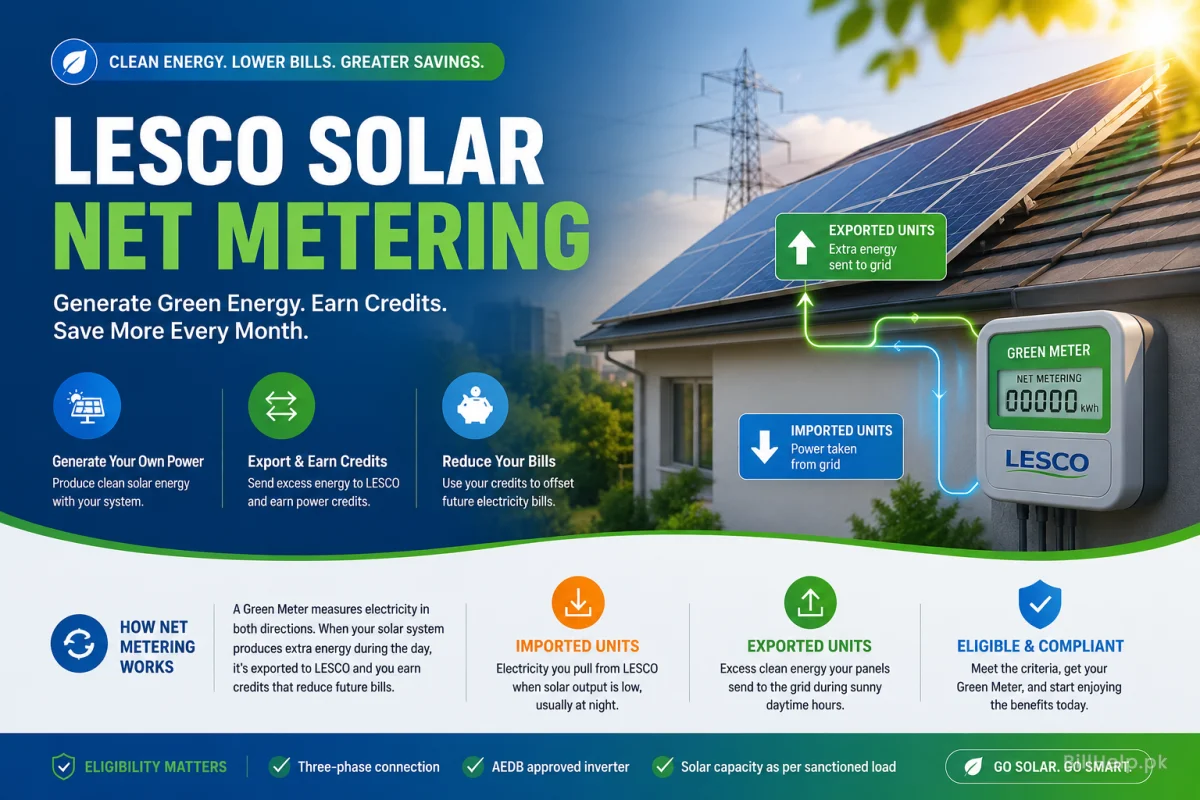
To record this two-way movement of energy, LESCO replaces your standard digital or electromechanical single-phase/three-phase utility meter with a Specialized Bi-Directional Smart Meter, commonly known in Pakistan as the "Green Meter" or AMI (Advanced Metering Infrastructure) Meter. This device keeps precise track of two primary billing metrics:
Energy Import
The electricity units (kWh) your property draws from the LESCO grid during times when solar output is insufficient or absent (e.g., at night, during heavily overcast days or when power demand exceeds solar generation capacity).
Energy Export
The solar units (kWh) generated by your PV system that exceed your immediate operational load and are sent into the LESCO neighborhood grid.
If you signed a net-metering agreement before 9 February 2026, LESCO still adjusts your exported units against your imported units until that agreement ends. New prosumers are billed under net billing: units you import are billed at the applicable tariff, and units you export are credited at the national average energy purchase price. Rooftop solar can help you convert your roof space into a localized energy production facility that can substantially lower your monthly electricity bills. This is a long-term financial security against rising utility tariffs in Lahore, Kasur, Okara and Sheikhupura.
Nepra Regulatory Framework and System Sizing Rules
Until 9 February 2026, net metering in Pakistan was regulated under the NEPRA (Alternative & Renewable Energy) Distributed Generation and Net Metering Regulations, 2015. These were repealed and replaced by the NEPRA (Prosumer) Regulations, 2026 (S.R.O. 251(I)/2026), which NEPRA amended in April and August 2026. System owners must meet the rules on sanctioned load, connection type, system size and grid capacity when applying to LESCO.
General Eligibility Criteria
- Sanctioned Load Limit: Under the 2026 regulations, the capacity of your proposed solar system shall not exceed the sanctioned load of your connection, shown on your latest monthly LESCO bill. For example, if the sanctioned load of your connection is 10 kW, then the maximum size of inverter that you can install is 10 kW.
- Three-Phase Connection Requirement: The 2026 regulations define an applicant as a 3-phase 400V or 11kV consumer, so a single-phase connection does not qualify. Single-phase consumers must apply for a 3-phase meter upgrade alongside or prior to initiating the net metering paperwork.
- System Size Boundaries: Distributed generation systems can range from 1 kW up to 1 MW (1000 kW). Domestic, commercial, industrial, agricultural and general services consumers can apply. A system of 250 kW or more needs a load flow study.
- Equipment Standards: Grid-connected inverters must comply with the UL 1741 standard, and you must install a manual disconnect device with a visible break so the system can be isolated from LESCO's lines.
System Capacity Guidelines for LESCO Prosumers
| System Size | Target Property Type | Required Sanctioned Load | Avg. Monthly Generation |
|---|---|---|---|
| 5 kW | Small Homes / 5 Marla | 5 kW – 7 kW | 600 – 650 Units |
| 10 kW | Medium Homes / 10-20 Marla | 10 kW – 12 kW | 1,200 – 1,350 Units |
| 15 kW | Large Residences / Small Offices | 15 kW – 18 kW | 1,800 – 2,000 Units |
| 20 kW – 25 kW | Commercial Outlets / Small Factories | 20 kW – 25 kW | 2,500 – 3,300 Units |
Generation figures are rough estimates. Actual output depends on your panels, their direction and the weather.
Step-wise LESCO Net Metering Approval Process
The application for the green meter is a systematic coordination between the system owner, the installer, LESCO and, for systems above 25 kW, NEPRA. Standard 6-stage workflow is as follows:
Site Survey & Load Feasibility Assessment
Your solar engineer validates grid availability at the local distribution transformer (T/F). Under the 2026 regulations, LESCO will not accept an application if the solar capacity already connected to that transformer has reached 80% of its rated capacity. The installer checks your existing LESCO billing record, current load, phase wiring and earthing pit values.
Application Dossier Preparation & Filing
The installer compiles the standard application form (Schedule-II of the 2026 regulations) along with technical datasheets, Single-Line Diagrams (SLD), equipment test reports and property documentation. This complete file is submitted to LESCO. LESCO must acknowledge it within 5 working days and tell you if anything is missing; you then have 3 working days to provide it. LESCO completes its initial review within 15 working days.
LESCO Technical Inspection & NOC Verification
A LESCO inspection team (comprising SDO or Assistant Manager Tech) visits the installation site. They check the installed solar panels and grid tie or hybrid inverter are as per the given specifications, check the mandatory AC and DC surge protection devices (SPD), perform earthing test and anti-islanding tests. In case of project approval, LECSO will issue a No Objection Certificate (NOC) for Technical Feasibility.
Agreement and NEPRA Concurrence or LESCO Approval
The prosumer and LESCO sign the standard Distributed Generation Interconnection Agreement within 7 working days. It runs for 5 years and can be renewed by mutual consent. For systems above 25 kW, LESCO forwards the case to NEPRA for concurrence, with a one-time fee of Rs 1,000 per kW; NEPRA can decide within 7 working days of receiving the documents. Since 6 August 2026, systems of 25 kW or below do not need NEPRA concurrence: LESCO gives the approval itself.
Payment & Testing Green Meter Demand Notice
LESCO issues the connection charge estimate (demand notice) within 7 working days of signing the agreement, and you pay it within 7 working days. It covers the bi-directional meter and the interconnection up to the connection point. The applicant shall make the payments from any of the authorized bank branches. The bi-directional meter is dispatched to the LESCO Metering and Testing (M&T) laboratory for testing and calibration.
Net Metering Activation, Commissioning and Meter Replacement
The M&T team at LESCO is replacing the existing electricity meter with calibrated new Green Meter. LESCO must install and commission the interconnection within 15 working days of your payment. Billing under net billing starts once NEPRA concurrence or LESCO approval has been granted.
Net Metering vs Net Billing in Pakistan
List of Required Documents
Proper documentation should be provided for any delay or rejection of the screening process by LESCO.
Personal and Ownership Documents
- Copy of CNIC of the LESCO Account Holder
- Ownership of Property (Allotment letter/fard/registry)
- Last 3 months LESCO Electricity Bills
- NOC from Property Owner (if property is registered in the name of landlord)
Technical & Engineering Submissions
- Standard application form (Schedule-II of the 2026 regulations)
- Single Line Diagram (SLD) approved from PEC licensed Engineer
- Inverter & PV Module Factory Test Certificates (IEC 62116 / UL 1741)
- Affidavit on Rs 50 non-judicial paper (Schedule-V, for cases needing NEPRA concurrence)
Green Meter Specifications & Technical DB Protection
LESCO requires strict compliance with safety protocols to protect grid infrastructure and field technicians from hazardous back-feeding during line load shedding or outages.
Bi-Directional Green Meter Specifications
Under the 2026 regulations, the metering must measure electricity flowing in both directions. LESCO can use one bi-directional meter or two separate meters (one for import, one for export). If LESCO has no meter available, you may buy one yourself, but LESCO must test it before installation.
Mandatory Distribution Board (DB) & System Protections
Your installer should provide full DC/AC protection. The 2026 regulations specifically require UL 1741-compliant inverters and a manual disconnect device with a visible break. A typical protection setup looks like this:
| Protection Layer | Equipment Required | Technical Purpose |
|---|---|---|
| Anti-Islanding Protection | Internal Inverter Relay (UL 1741 / IEC 62116) | Automatically shuts off solar feed within milliseconds if LESCO grid power drops, preventing electrocution of utility workers. |
| AC Side Protection | 3-Phase AC Circuit Breaker (MCB/MCCB) + AC SPD Class II | Guards the inverter and internal home wiring against AC grid voltage spikes and high current short circuits. |
| DC Side Protection | 1000V DC Breaker + DC Fuses + DC Surge Protection Device (SPD) | Protects the inverter from atmospheric lightning strikes, high DC static and PV string short circuits. |
| Earthing / Grounding System | Dual Copper Earthing Pits (< 5 Ohms resistance) | Separate, dedicated grounding pathways for equipment chassis (AC/DC) and lightning surge arrestors. |
| Manual AC Breaker / Isolator | Lockable AC Disconnect Switch | External physical switch mounted near the meter box allowing LESCO personnel to manually isolate solar feed during line repairs. |
Solar Connection Costs and Payback
The cost analysis is important for the calculation of return on investment for the project. The total cost includes costs of hardware equipment, installation cost, vendor processing fees and LESCO demands.
Processing and Hardware Cost Estimates (market estimates, not official rates)
| Expense Category | Approximate Cost (PKR) | Notes / Details |
|---|---|---|
| NEPRA Concurrence Fee | Nil for 25 kW or less; Rs 1,000 per kW above 25 kW | Official one-time fee paid to NEPRA (S.R.O. 709(I)/2026). LESCO's own charges are shown in its connection charge estimate. |
| 3-Phase Bi-Directional Smart Meter | PKR 25,000 – 45,000 | Includes testing, calibration, and smart SIM module installation. |
| Technical Protection DB Box & Wiring | PKR 18,000 – 35,000 | Covers AC/DC SPDs, breakers, copper earthing wire and lockable box. |
| Vendor Consultancy & Licensing Overhead | PKR 25,000 – 40,000 | Includes SLD engineering stamping, LESCO coordination, and NEPRA filing. |
| Total Setup Overhead (approx.) | PKR 70,000 – 120,000 | Excludes primary solar panel and inverter cost. |
Payback Under Net Billing
Older payback figures, often quoted as 3 to 4 years, assumed net metering. Under net billing, exported units earn the national average energy purchase price, not the tariff you pay for imported units, and NEPRA can revise that rate during your agreement. So your payback now depends mostly on how much of your solar power you use yourself. Ask your installer for a calculation based on your own bills.
How LESCO Solar Bills Work (2026)
How your solar bill works depends on when you signed your agreement with LESCO.
1. Old Net-Metering Agreements (signed before 9 February 2026)
Under the 2015 regulations, LESCO nets off the units you export against the units you import in each billing cycle. If you imported more, you pay for the net units at the applicable tariff. If you exported more, the net units are credited to your next bill or paid to you quarterly. Under S.R.O. 547(I)/2026, these terms continue until your agreement expires. They end early if you make a material change that alters your system's maximum output.
2. New Prosumers: Net Billing (since 9 February 2026)
Important Regulatory Note: Under the NEPRA (Prosumer) Regulations, 2026, units you take from LESCO are billed at the applicable tariff, and units you export are credited at the national average energy purchase price. NEPRA can revise this rate during your agreement. Because your bill for imported units also includes items such as fuel price adjustments (FPA) and taxes, the single most effective strategy to maximize return on investment in 2026 is maximizing daytime self-consumption (running heavy appliances like inverter ACs, water pumps and electric motors while solar generation is at its peak).
3. Financial Credit Rollover & Settlement
Under net billing, if the value of the units you export in a billing cycle is more than the value of the units you import, LESCO credits the difference to your next bill or pays it to you quarterly.
Frequently Asked Questions (FAQs)
FINAL SUMMARY JUDGMENT
Even after the 2026 switch to net billing, rooftop solar with a green meter can still cut your LESCO bills, especially if you use most of your solar power during the day. Check the current NEPRA rules and your own consumption before you invest.