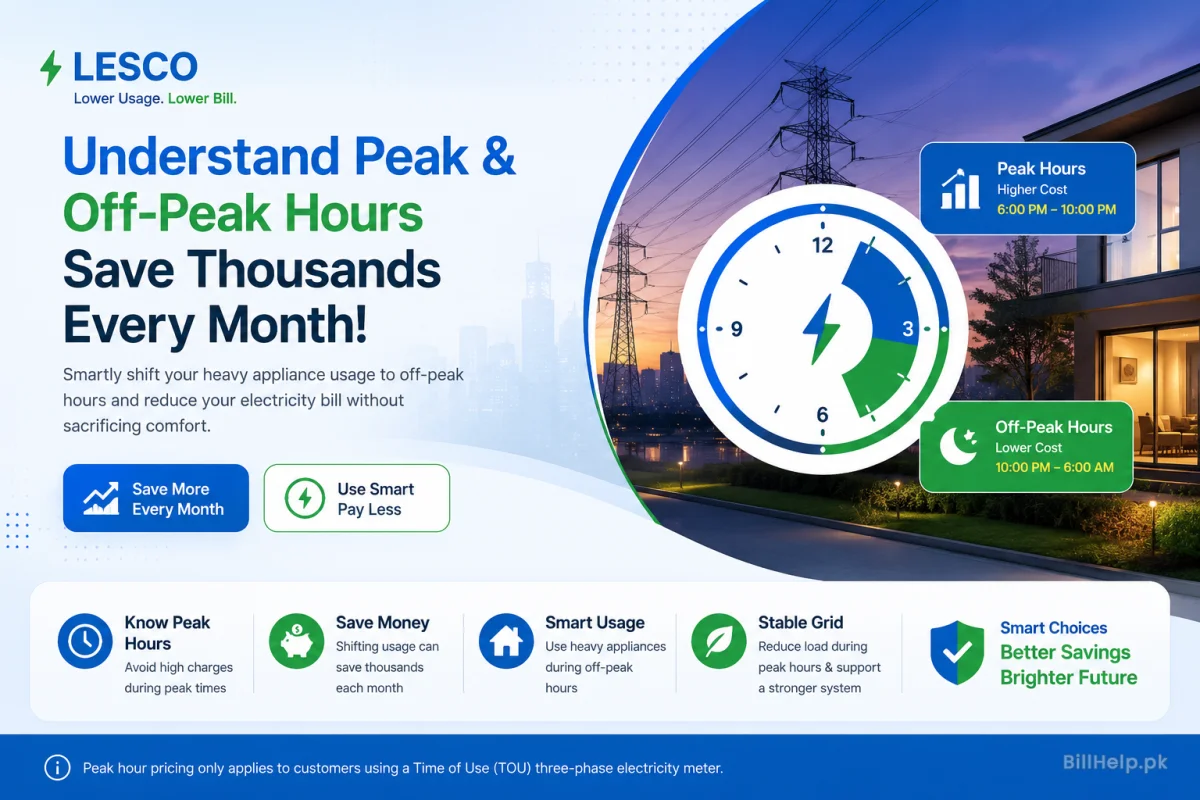
LESCO's peak hours are 5 PM to 9 PM from December to February, 6 PM to 10 PM from March to May, 7 PM to 11 PM from June to August and 6 PM to 10 PM from September to November. The other 20 hours of each day are off-peak. These timings only change your bill if you have a time-of-use (TOU) meter.
Many people hear "peak hours" and switch off everything at 7 PM. That can help the grid. But for most homes in Lahore, it does not change the rate on the bill. This guide explains who actually pays peak rates, how to read them on a LESCO bill, and how to work out whether shifting your load is worth it.
Need your bill first? Use our LESCO bill check with your 14-digit reference number.
LESCO peak and off-peak timings
| December to February | 5:00 PM – 9:00 PM |
| March to May | 6:00 PM – 10:00 PM |
| June to August | 7:00 PM – 11:00 PM |
| September to November | 6:00 PM – 10:00 PM |
Off-peak is the remaining 20 hours. The same timings appear on LESCO's own tariff page and in NEPRA's 2026 tariff decision for LESCO. NEPRA's terms also say the timings are to be adjusted if daylight saving time is used.
Official sources: LESCO electricity tariffs and NEPRA tariff decisions for LESCO.
Who pays a different rate in peak hours?
Peak pricing applies to connections billed on a time-of-use tariff. LESCO's tariff schedule puts these groups on TOU:
- Homes with a sanctioned load of 5 kW or more. Homes under 5 kW are billed by slabs instead.
- Shops and offices (commercial tariff) with a sanctioned load of 5 kW or more.
- Most industrial connections, which have their own TOU tariffs.
Your sanctioned load is printed on your bill. If it is under 5 kW and your bill shows one reading line, you are on slab billing. Units used at 8 PM cost the same as units used at noon. Your concern is the total number of units in the month, not the time you use them.
How to spot a TOU bill
A TOU bill has two readings instead of one:
Peak reading
Units recorded only during the peak window. These are charged at the higher peak rate.
Off-peak reading
Units recorded in the other 20 hours. These are charged at the lower off-peak rate.
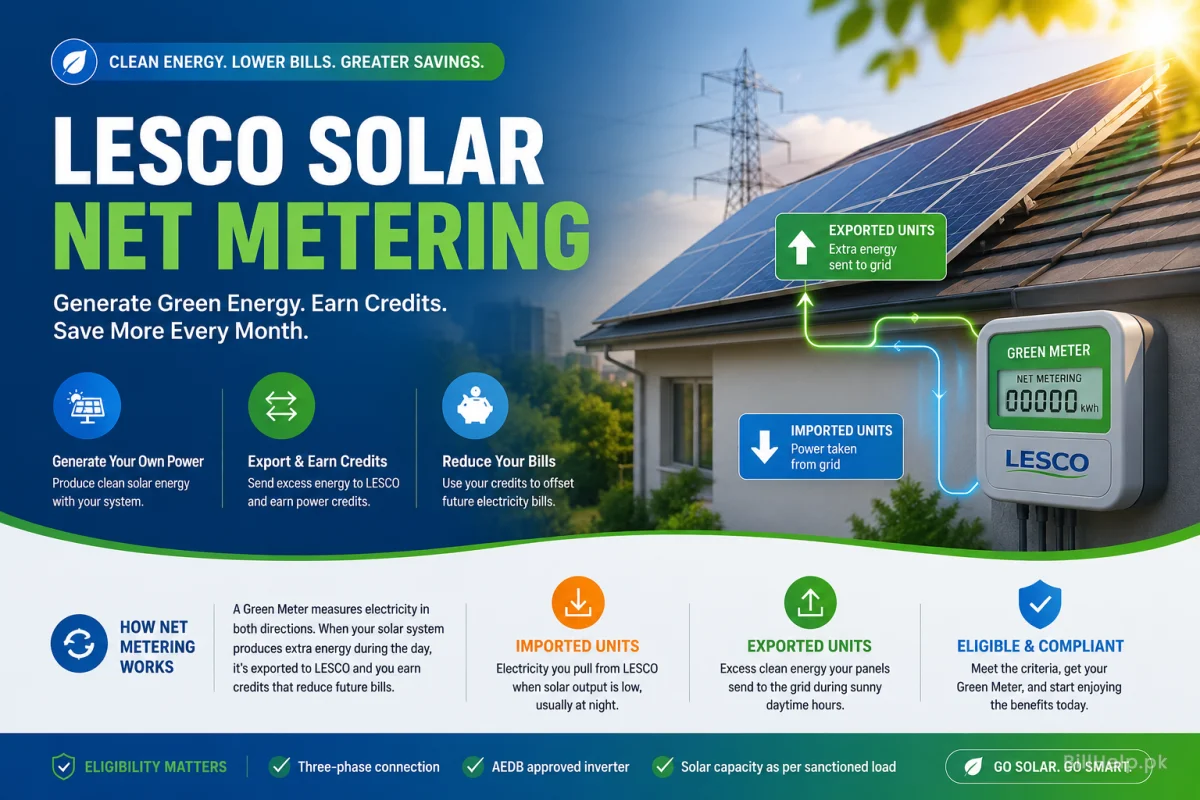
If you have solar net metering, your bill also shows exported units. Our LESCO bill reading guide explains each line.
Is shifting load worth it? Do the maths
The rates change when NEPRA revises the tariff, so we do not print them here. Take them from your own bill or the latest NEPRA notification. Then use this simple formula:
Example with made-up rates: say your peak rate is Rs 10 higher than your off-peak rate. You move a 1 kW motor that runs one hour a day from 8 PM to 4 PM. That is about 30 units a month. Your saving is roughly 30 × 10 = Rs 300, before taxes. Replace the Rs 10 with the real gap on your bill to see your real saving.
Sales tax is charged on the cost of electricity, so a lower energy cost also lowers the tax on it.
What to move out of peak hours
For TOU users, the best targets are big loads that do not need to run at a fixed time:
- Water motors: fill the roof tank in the afternoon or at night.
- Electric iron and washing machine: do the week's ironing and washing in the morning.
- Air conditioners in shops and offices: cool the space before the peak starts, then raise the thermostat a little.
- Electric heaters and geysers in winter: heat water before 5 PM.
- Industrial machines: plan long runs for off-peak shifts where the work allows.
Lights, fans and phone chargers use few units. Moving them saves very little.
Peak hours are not load shedding
Peak hours are a pricing window. Load shedding is a supply cut. They are different schedules. LESCO publishes load shedding and shutdown times on its load shedding schedule page. Our LESCO load shedding guide shows how to find your feeder.
On slab billing? Watch the 200-unit line instead
For most homes under 5 kW, the bigger risk is crossing a slab. A home that uses 200 units or less each month for six months in a row is treated as "protected" and pays lower rates. One month above that can change the picture. Read why a bill jumps after 200 units and our tips to cut your units.
Frequently asked questions
Do LESCO peak hours apply on Sundays and holidays?
Yes. The tariff gives the peak window as a time of day for each season. It does not exclude weekends.
Does my home pay higher rates in peak hours?
Only if you are on a time-of-use tariff, which LESCO's schedule applies to homes with a sanctioned load of 5 kW or more. Smaller homes are billed by slabs.
Where can I see my peak and off-peak units?
On a TOU bill, the readings and units are shown separately for peak and off-peak. You can also see the latest bill on the official PITC page or on our LESCO bill page.
Can I ask LESCO to put me on a TOU meter?
Ask your subdivision office. The meter and tariff depend on your sanctioned load and connection type, so they will tell you what applies to you.