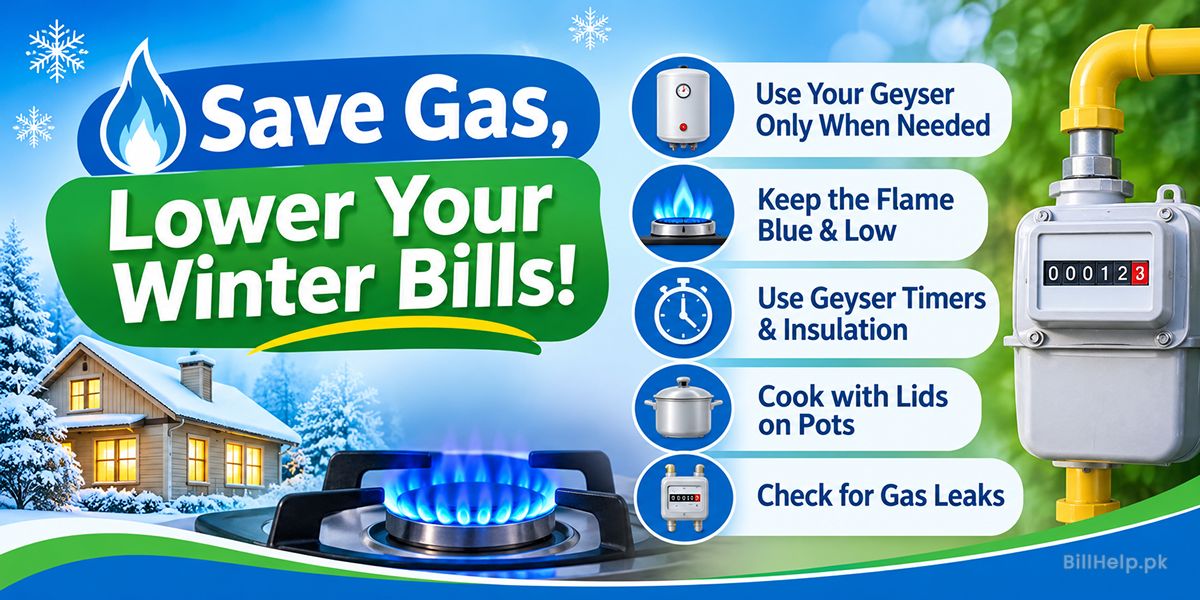
November is when the gas meter starts to spin faster. The good news is that most of a winter gas bill comes from two or three habits you can change this week, and both gas companies have published what they want you to change.
The short version
Run the geyser on a schedule, not all day. Keep its thermostat low. Cook with a lid and a blue flame. Do not heat a room with an open gas heater. Fix leaks on your side of the meter, because that gas is billed to you.
This guide covers homes on SNGPL (Punjab, Khyber Pakhtunkhwa and Islamabad) and SSGC (Sindh and Balochistan). The saving advice is the same for both. Where the two companies differ, it is marked.
The bathroom: start with the geyser
A conventional geyser keeps a large tank of water hot all day, even when nobody is using it. That is why it is the first thing both companies talk about.
- Lower the thermostat. SNGPL's residential energy guide says each 5°C drop in water temperature can cut the geyser's gas use by up to 5%. Its winter campaign asks people never to keep the dial on "Very Hot", and to use "Warm" or "Off" in busy hours.
- Turn it off when you do not need hot water. SNGPL repeats this in almost every campaign. A geyser that heats water only for the morning and evening uses far less gas than one left on.
- Take showers, not tub baths. SNGPL's guide puts a typical bath at about 75 litres of hot water, and a 5-minute shower with an efficient shower head at about half of that.
- Insulate. SNGPL suggests keeping a conventional geyser in an enclosed but ventilated place, and insulating the main water pipes and the overhead tank.
- Get it serviced. SNGPL's geyser poster warns that a faulty thermostat, regulator or pilot wastes gas all the time. It asks you to have the geyser checked regularly, repair rusted body sheets, use a proper pipe instead of a rubber pipe, and take extra care in hard-water areas.
Three devices that do the work for you
Geyser timer
Fits on the existing thermostat. You set on and off times from a phone app, and the geyser drops to its pilot flame in between. SNGPL's 2022-23 sustainability report says it can save 20% to 30% of gas use. SSGC's FAQ also recommends smart timer devices.
Conical baffle
A cone fitted inside a conventional geyser, shown on SNGPL's gas saver poster. Both SNGPL and SSGC recommend it. SNGPL says it improves a conventional geyser's efficiency significantly.
Instant or solar heater
An instant geyser heats water only while the tap is open, so there is no tank to keep hot. SNGPL and SSGC both suggest it. SNGPL also promotes solar water heaters.
SNGPL customers only: SNGPL's sustainability report says solar water heaters, geyser timers and conical baffles are available at SNGPL offices, with the cost recovered through instalments on your gas bill and no profit added. One of its posters gives helpline 1199 for the gas saver cone.
These details come from SNGPL's 2022-23 report and an older poster, so ask 1199 or your SNGPL office first whether the scheme is still running in your area. SSGC's FAQ recommends the same devices but does not say it supplies them.
The kitchen: smaller flame, shorter time
Cooking uses less gas than a geyser, but it happens every day of the year. SNGPL's residential guide and SSGC's FAQ list these steps:
- Keep the flame blue. SNGPL says a blue flame is more efficient than a yellow one, and a clean burner helps it stay blue.
- Keep the flame under the pot. A flame that climbs up the sides heats the kitchen, not the food.
- Put a lid on. Covered water boils faster.
- Use a pressure cooker. SSGC names it in its list of ways to cut the bill.
- Cook vegetables in a small amount of water and do not overcook them.
The sitting room: heat yourself, not the air
SNGPL's winter posters say plainly: wear warm clothes instead of using a gas heater. A gas heater uses up the oxygen in a room and can be a danger to life. Its campaign also asks people not to run the heater and the stove at the same time, and to turn off every gas appliance before going to bed.
If you still use a heater, the point of these rules is safety first and saving second. Keep the room ventilated and never sleep with it on.
The pipes: leaks on your side are your cost
The meter belongs to the company. Everything after it belongs to you. SSGC's FAQ says the customer alone is responsible for the house line and fittings after the meter, and any gas lost through an internal leak is billed to the customer. SNGPL's campaign asks people to check for leaks regularly.
If you smell gas, treat it as an emergency, not a bill problem. Both companies take leak calls on 1199. SSGC's FAQ says its call centre runs round the clock all year. For other complaint routes, see the SNGPL helpline guide or the SSGC helpline guide.
The bill: small habits that protect your slab
| Point | SNGPL | SSGC |
|---|---|---|
| Price check before the bill | Bill Estimator on sngpl.com.pk | Domestic Bill Calculator on ssgc.com.pk |
| Slab rule worth knowing | See our SNGPL slab guide | FAQ: you get the benefit of the one slab before yours only |
| Late payment | Amount after due date is printed on the bill | FAQ: 10% of the current bill for homes |
| Allowed use per meter | Check your gas supply contract | FAQ: one kitchen and one geyser |
Gas slabs are why one cold week can cost so much. Use rises, and the rate on that use can rise with it. The SSGC tariff guide and the SNGPL slab guide explain the protected and non-protected groups. If a winter bill has already arrived and is too big, SSGC's FAQ says you can ask any Customer Facilitation Centre for instalments.
You asked
Which saves more: a timer or a new geyser?
A timer works with the geyser you already have. An instant geyser removes the hot tank altogether. If the old geyser is rusted or its thermostat is faulty, SNGPL's advice is to repair or service it first, since a faulty one wastes gas all the time.
Is a conical baffle meant for an instant geyser?
SNGPL describes the baffle as a way to improve a conventional geyser, the type with a storage tank. Ask a qualified plumber before fitting anything to an instant geyser.
My bill jumped but my habits did not change. What now?
Look for a leak after the meter, a geyser pilot or thermostat fault, or a provisional bill. SSGC's FAQ says provisional bills are issued when the meter is not read, and are adjusted later against the actual reading. If none of these explains it, file a complaint through 1199.
Is it safe to leave the geyser on pilot overnight?
SNGPL's campaign asks you to turn off all gas appliances before bed. A timer that drops the geyser to its pilot is meant for the hours between uses in the day.
Who pays to fix a leak inside my house?
You do. SSGC's FAQ says repairs after the meter are the customer's job. Use a qualified plumber.
Sources: SNGPL "Energy Conservation for Residential Consumers" in its Energy Focus booklet (sngpl.com.pk/pdf/energyfocus.pdf); SNGPL Sustainability Report 2022-23, Energy Conservation Devices; SNGPL Gas Conservation campaign pages and posters on sngpl.com.pk (conservancy campaign, geyser maintenance, geyser timer device, conservation devices, heater safety); SSGC Frequently Asked Questions (Q3, Q5, Q11, Q15, Q18, Q19, Q21, Q25); SSGC Domestic Bill Calculator. All checked 10 November 2026.