The fastest way to cut an electricity bill is not a list of random tips. It is knowing which appliances eat your units, then fixing those first. This guide shows you how to measure your home's use with simple maths, where the big savings are, and how to stay under the slab that keeps your rate low.
These steps work for every company, from LESCO and IESCO to MEPCO and K-Electric. To see your latest bill and units, check your electricity bill with your reference number.
Step 1: Learn to count units
One unit on your bill is one kilowatt-hour (kWh). That is 1,000 watts used for one hour. You can work out any appliance's units with one line of maths:
The watts are printed on the appliance's label or in its manual. Some examples:
| If the label says | And you use it | Units per month |
|---|---|---|
| 100 W (ceiling fan) | 10 hours a day | 100 × 10 × 30 ÷ 1,000 = 30 |
| 1,000 W (iron) | 30 minutes a day | 1,000 × 0.5 × 30 ÷ 1,000 = 15 |
| 750 W (water motor) | 1 hour a day | 750 × 1 × 30 ÷ 1,000 = 22.5 |
| 1,500 W (air conditioner) | 8 hours a day | 1,500 × 8 × 30 ÷ 1,000 = 360 |
These are example figures. Use the real watts from your own appliances. An AC or fridge does not run at full power all the time, so its real use is often lower than the label suggests.
Do this for your five biggest appliances. You will usually find that one or two of them make up most of your bill.
Step 2: Read your meter for one week
Write down your meter reading at the same time every day for a week. The difference between two days is how many units you used that day. Then try one change, such as running the AC two hours less, and see how much the daily number falls.
This also protects you from a wrong bill. If your own readings and the bill do not match, you have proof. See what to do about a high bill.
Step 3: Fix the big loads first
Air conditioner
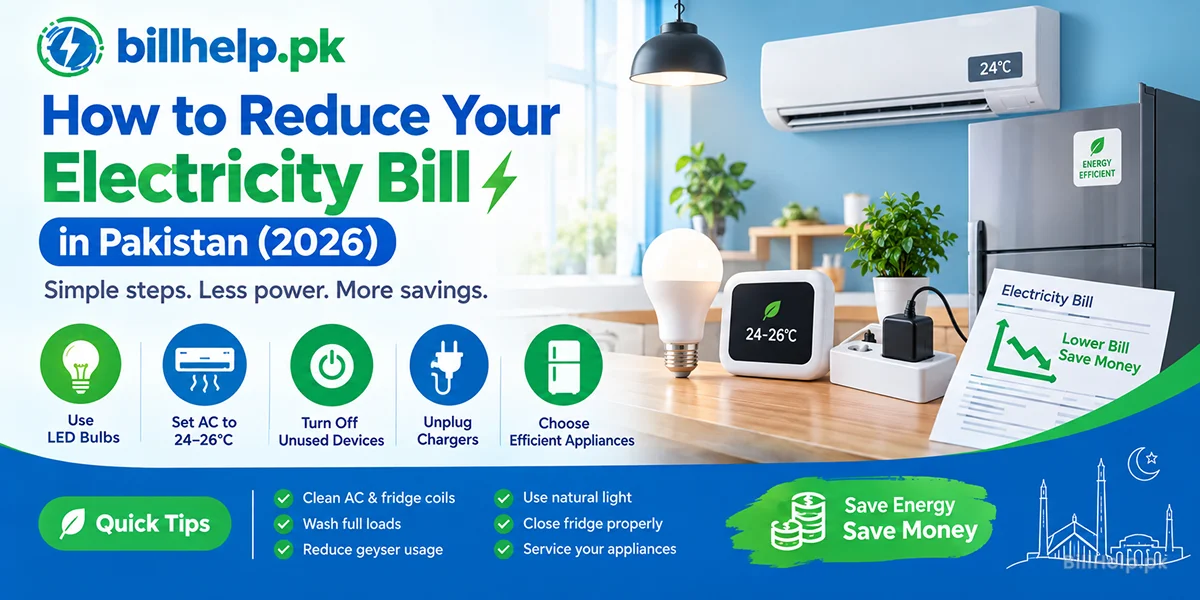
- Set it to 26°C instead of 18°C. The compressor runs less when the gap between inside and outside is smaller.
- Use a ceiling fan with the AC. The moving air feels cooler, so you can keep the thermostat higher.
- Clean the filters every two weeks in summer. A clogged filter makes the unit work harder.
- Close doors and curtains in the cooled room. Shade the outdoor unit if it sits in direct sun, but keep its air flow clear.
Water motor
- Fix overflowing tanks. Many homes run the motor long after the tank is full.
- An automatic water level switch turns the motor off when the tank is full.
Fridge and freezer
- Check the door seal. Close the door on a sheet of paper. If it slides out easily, the seal may need replacing.
- Leave a gap behind the fridge so heat can escape, and do not put hot food inside.
Electric geyser, heater and iron
- Switch the geyser on only before use, not all day.
- Iron the week's clothes in one go, so the iron heats up once.
Step 4: Cheap swaps that pay back
- LED bulbs: an LED uses a small part of the power of an old filament bulb for the same light.
- Inverter AC or fridge: when you replace an old unit, an inverter model adjusts its speed instead of switching fully on and off. Compare the energy label before you buy.
- Efficient fans: newer DC or "energy saver" fans use fewer watts than old models. Check the watts on the box.
Unplugging chargers and TVs on standby saves only a little. Do it, but do not expect it to change your bill much.
Step 5: Watch the 200-unit line
For homes, the slab you fall in matters as much as the units. A home that uses 200 units or less each month for six months in a row is treated as protected and pays lower rates. Crossing 200 units, even once, can move you to higher rates for months.
So check your meter around the 20th of the month. If you are close to 200 units, cut back on the AC and motor for the last few days. Our homepage meter reading tracker can estimate your month-end units for you.
Step 6: Know what you cannot cut
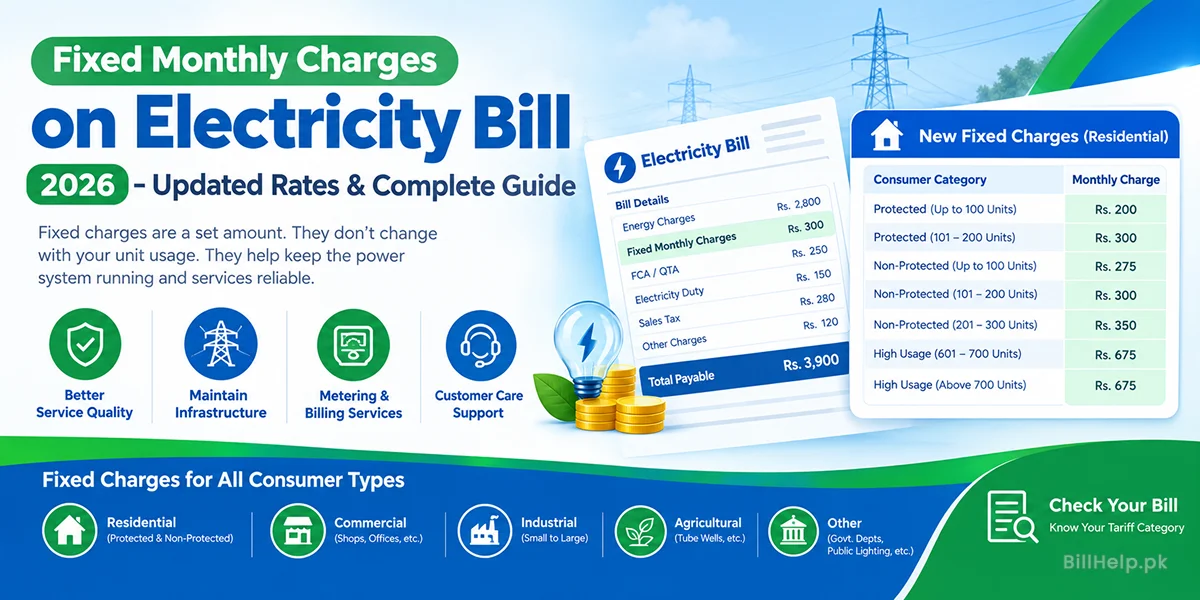
Some lines on the bill do not depend on how careful you are. These include taxes, the fuel cost adjustment decided by NEPRA each month and, for some homes, a fixed monthly charge. Read our guide to fixed monthly charges so these do not surprise you.
If your home has a time-of-use meter, moving heavy loads out of the evening peak also helps. Most smaller homes are billed by slabs, so the time of use does not change their rate. See peak and off-peak hours to check which applies to you.
Thinking of solar? Our guide to net metering vs net billing explains how exported units are paid for now.
Frequently asked questions
How do I work out how many units an appliance uses?
Multiply its watts by the hours you use it each day and by 30, then divide by 1,000. That gives the units per month.
Which appliance uses the most electricity at home?
In most homes in summer it is the air conditioner, followed by the water motor, iron and fridge. Check the watts on your own appliances to be sure.
What AC temperature saves electricity?
A higher setting, such as 26°C, uses less power than a very low one. Use a fan with the AC to stay comfortable.
Why does staying under 200 units matter?
Homes that use 200 units or less each month for six months in a row get protected, lower rates. Going above 200 units can mean higher rates.
Official sources to check:NEPRA · PITC complaint portal (CCMS)