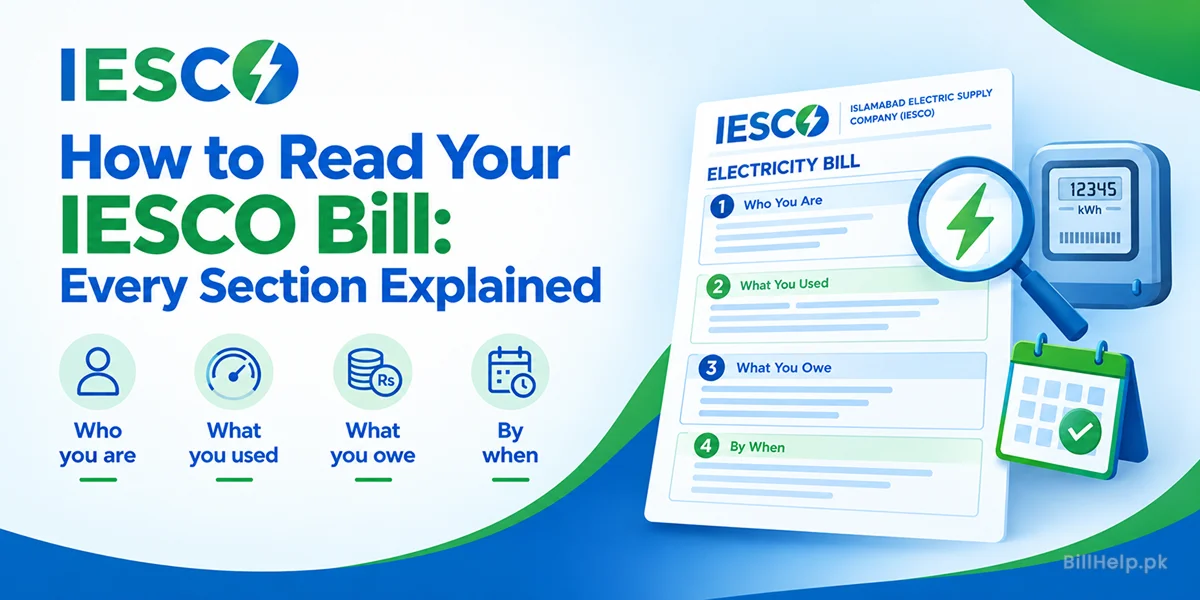
Pick up your latest IESCO bill. Lay it flat. It looks busy, but it only does four jobs: it says who you are, what you used, what you owe and by when.
We will go through it in that order. The meanings below come from NEPRA's Consumer Service Manual, which lists what every electricity bill should contain, and from IESCO's own FAQ. Box positions can change when bills are redesigned, so look for the name of each field.
Don't have your bill? View it on our IESCO bill check page with your reference number.
Part 1: Who you are
Reference No.
A dedicated number given to your connection for identification. You need it to check and pay the bill.
Name and address
The name and address of the consumer. Bought a house and the bill is in the old owner's name? IESCO says a change of name is applied for like a new connection.
Tariff
Your category, such as residential or commercial. It decides the NEPRA-approved rates you pay.
Load and meter no.
Load is the sanctioned load of your connection. The meter number identifies your billing meter.
The bill should also show your division, sub-division and feeder name, plus contact numbers for complaints and for your XEN and SDO.
Part 2: What you used
This part is about your meter. Check it against the meter at home.
- Reading date: the day your meter was read.
- Previous reading: the reading taken on last month's reading date.
- Present reading: the reading taken on this month's reading date.
- Units consumed: the units used in the billing period. If your meter is defective, this is an average.
- Snapshot: a picture of the present meter reading.
The bill also has a billing history. It shows 12 months of bills and payments. Our IESCO bill history guide explains how to use it.
Part 3: What you owe
This is where most questions come from. Here is each charge in one line.
| On the bill | What it means |
|---|---|
| Cost of electricity | The cost of your units at your tariff's rates (or of average units if the meter is defective). |
| Fixed charges | A charge set in the tariff terms and conditions. |
| GST | General Sales Tax, levied by the Government of Pakistan. |
| ED | Electricity Duty, levied by the provincial government. |
| Other charges | Items such as Fuel Price Adjustment (FPA), Quarterly Tariff Adjustment (QTA), Financing Cost surcharge, PTV fee and withholding tax. |
| Installments | Any amount due under installments allowed by the competent officer. |
| Deferred amount | An amount the company has deferred. |
| Arrears | Unpaid amount from earlier bills. |
Definitions: NEPRA Consumer Service Manual, bill contents table.
Want to know the rates behind these numbers? See our IESCO tariff and bill calculator guide. For fixed charges in more detail, read electricity bill fixed monthly charges.
Your bill may also have a QR code. Our IESCO bill QR code guide explains what it is for.
Part 4: By when
Issue date
The day the bill was issued to you.
Due date
The last day to pay the "within due date" amount. If it falls on a holiday, it moves to the next working day.
After due date
The amount if you pay late. It adds the Late Payment Surcharge (LPS).
The amount payable within due date is the total of all current items, including any arrears.
Your 60-second bill check
- Is the name, address and tariff right?
- Does the present reading match your meter?
- Do the units look normal next to your billing history?
- Are there arrears you already paid? IESCO's FAQ says these can be corrected if you show your previous bill's bank receipt.
- Note the due date and pay before it.
Something wrong? Use our IESCO complaint guide or call 118.
Frequently asked questions
Sources: NEPRA Consumer Service Manual, section 6.4 "Electricity bill" (as published on iesco.com.pk); IESCO FAQs. Checked 10 October 2026.