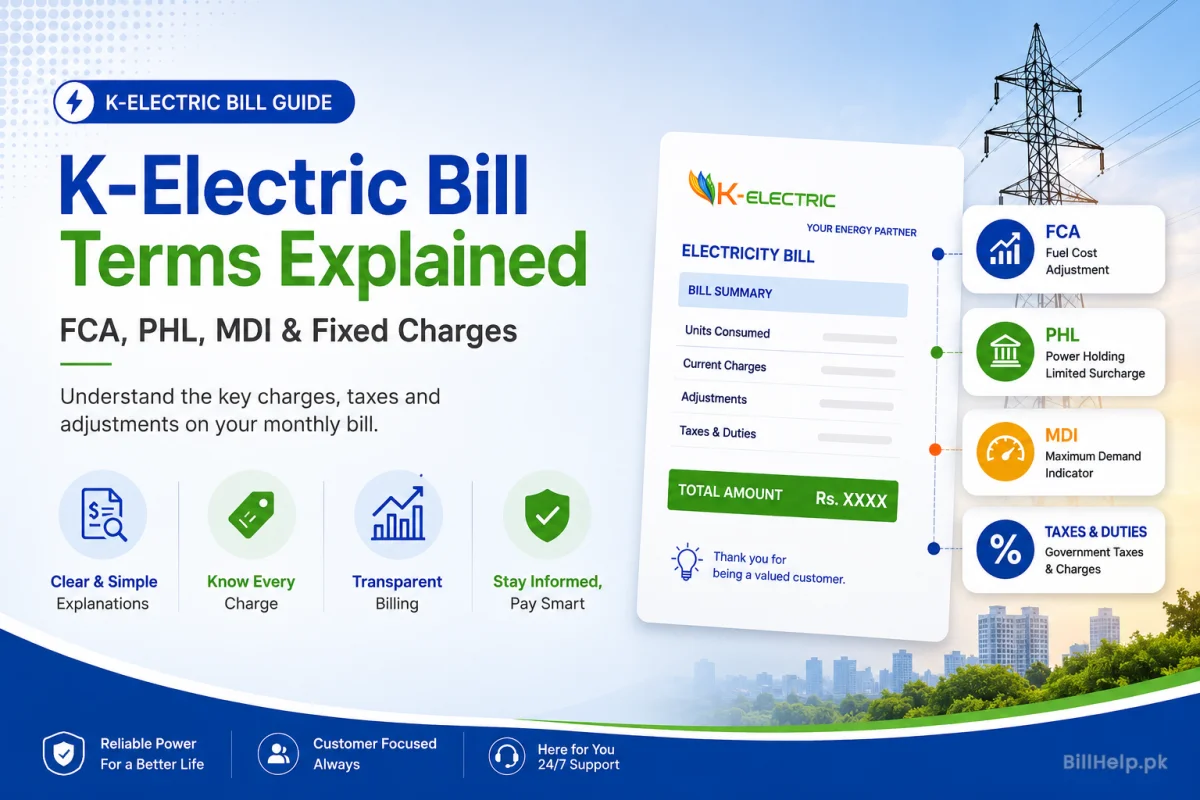
K-Electric Bill Terms Explained: What are FCA, PHL, MDI, and Fixed Charges?
I will help you understand every term, acronym, tax and surcharge printed on your monthly K-Electric electricity bill statement using simple plain English.
Why Does Your K-Electric Bill Contain Many Charges?
When you look at your K-Electric electricity bill you will see many terms like FCA, PHL, MDI and Fixed Charges. Many people wonder why these charges appear on a K- electricity bill alongside the basic cost of the electricity used.
These items represent fuel price adjustments, debt servicing surcharges peak power demand indicators and fixed capacity fees. These fees are set under regulatory frameworks, by NEPRA (National Electric Power Regulatory Authority). I believe that understanding these terms helps you check if your K-Electric electricity bill is correct and helps you manage your electricity budget better.
1. Introduction to K-Electric Billing Terms
K‑Electric also called KE, generates, transmits and distributes electricity to than 2.5 million customers in Karachi, Dhabeji, Gharo and Hub in Balochistan.
Your monthly bill is made of three parts: Basic Energy Charges, which come from the units you use; Regulatory Surcharges and Fuel Adjustments such as FCA, PHL and QTA; and Mandatory Government Taxes, such, as Sales Tax and Electricity Duty.
When you understand what each line means you can spot mistakes quickly see rate increases approved by NEPRA and change habits to lower your utility expenses.
2. What is FCA or Fuel Cost Adjustment and FPA or Fuel Price Adjustment?
FCA – Fuel Cost Adjustment (also referred to as FPA or Fuel Price Adjustment) It represents the difference between the estimated fuel cost on which initial electricity tariffs are based and the actual fuel cost incurred in power plants to generate electricity.
Electricity in Pakistan is generated from different fuels such as Furnace Oil (RFO), Re-gasified Liquified Natural Gas (RLNG), Coal and Natural Gas. Power generation costs fluctuate each month as global fuel prices are constantly changing in international markets.
Positive FCA (SurCharge)
When global fuel prices go up, actual generation costs exceed NEPRA’s baseline estimates. NEPRA approves a positive FCA. This means a small charge per unit (eg +Rs 1.40/kWh) is added to your monthly bill.
Negative FCA (Bill Relief / Discount)
Actual costs are lower than estimates when global fuel prices drop or there is an increase in cheap local generation. NEPRA approves a negative FCA, giving customers a per-unit discount (e.g., -Rs 3.00/kWh) on their bill.
Why Does FCA Show Up a Month or Two Later?
FCA calculations require complete monthly fuel expense audits. NEPRA holds public hearings before approving monthly FCA petitions. Therefore, the FCA on your current bill statement reflects the fuel cost adjustment from 1 or 2 months prior.
3. What is the PHL Surcharge?
PHL stands for Power Holding Limited Surcharge. You might see the PHL (Power Holding Limited) Surcharge listed on your bills as an Additional Surcharge or an FC Surcharge.
Power Holding Limited is a group owned by the government. The government created Power Holding Limited to deal with debt in the energy sector of Pakistan. For a time unpaid subsidies, lost power and late payments caused a huge amount of circular debt in the national power grid.
The Federal Government needs to pay interest on loans used to fix this debt. Because of this the Federal Government adds the PHL Surcharge to the electricity bills of all consumers. This happens across all distribution companies, including DISCOs and K-Electric because of the tariff rules.
Key Facts About PHL Surcharge:
- The PHL Surcharge is a fixed amount charged for every unit you use (for example Rs 3.23, per kWh) based on your electricity consumption.
- It is determined by the Federal Ministry of Energy and notified by NEPRA.
- K-Electric does not keep this money; KE collects it directly on behalf of the Federal Government.
- Protected residential consumers using up to 200 units per month are typically exempted from heavy additional surcharges.
4. What is MDI (Maximum Demand Indicator)?
MDI stands for Maximum Demand Indicator. It measures the highest amount of electrical power (in Kilowatts - kW or Megawatts - MW) your connection draws at any single point during a billing month.
Modern digital electricity meters record power demand continuously in 15-to-30 minute intervals. The highest peak demand recorded during the entire month is registered as your MDI value.
MDI applies mainly to 3-phase domestic connections, commercial connections (A2 tariff), industrial connections (B1, B2, B3, B4 tariffs), and Time-of-Use (ToU) meter users with sanctioned load of 5 kW or above.
How MDI Charges Are Billed:
Where fixed charges apply per kW per month, K-Electric bills fixed charges based on 25% to 50% of your Sanctioned Load OR your Actual MDI Reading, whichever is higher.
How to Prevent High MDI Charges:
If you run high-power appliances (like multiple central air conditioners, industrial motors, or heavy water pumps) all at the exact same time, your MDI spikes up.Stagger your heavy electrical loads so that they don’t run at the same time to keep your MDI low.
5. What are Fixed Charges and Monthly Capacity Charges?
Fixed Charges are monthly charges per Kilowatt (kW) of sanctioned load or connection type. It is them who are paying for the maintenance of power generation capacity, transmission lines, transformers and grid infrastructure.
The fixed monthly charges are applicable on domestic, commercial and industrial connections under revised national tariff guidelines of NEPRA depending upon the category of the sanctioned load.
| Consumer Category | Monthly Usage / Slab | Fixed Charge Rate (Rs/kW/Month) |
|---|---|---|
| Protected Domestic | 1 - 100 Units | Rs 200 / kW |
| Protected Domestic | 101 - 200 Units | Rs 300 / kW |
| Non-Protected Domestic | 1 - 100 Units | Rs 275 / kW |
| Non-Protected Domestic | 101 - 200 Units | Rs 300 / kW |
| Non-Protected Domestic | 201 - 300 Units | Rs 350 / kW |
| Non-Protected Domestic | 301 - 400 Units | Rs 400 / kW |
| Non-Protected Domestic | 401 - 500 Units | Rs 500 / kW |
| Non-Protected Domestic | 501 - 600 Units & Above | Rs 675 / kW |
| Commercial (A-2) & Industrial (B1-B2) | 5 kW & Above Sanctioned Load | Rs 500 to Rs 1,250 / kW |
Note: Fixed charges are mandatory monthly capacity charges. They apply even if no electricity is consumed during the month, because the utility keeps grid capacity reserved for your sanctioned load.
6. What is QTA (Quarterly Tariff Adjustment)?
QTA stands for Quarterly Tariff Adjustment (often listed on bills as Uniform Quarterly Adjustment).
FCA is updated on a monthly basis due to fluctuations in fuel costs, while QTA is calculated every three months (quarterly) by NEPRA. The QTA covers the effect of changes in power capacity payments, transmission and distribution losses, operating costs and fluctuations in exchange rates.
QTA adjustments are aimed at ensuring uniform electricity tariff rates at the national level among all the power distribution companies of Pakistan.
7.Details of Government Taxes & Statutory Levies
Besides energy charges and surcharges, your monthly bill statement also includes the following additional government taxes:
Electricity Duty (ED)
A provincial tax imposed by the Sindh Government on electricity consumption charges (usually 1.5% to 2% of variable charges).
General Sales Tax (GST)
A federal sales tax (under section 3(1) of the Sales Tax Act 1990) applied at standard statutory tax rates on cumulative energy charges and surcharges.
MUCT / KMC Tax
Municipal Utility Charges Tax collected by KE on behalf of the Karachi Metropolitan Corporation (KMC) for civic development services.
PTV License Fee
A standard monthly charge of Rs 35 for residential connections and Rs 60 for commercial connections added for state broadcasting services.
8. Understanding Account Numbers, Reference Numbers & Sanctioned Load
To prevent payment errors learn about the identification terms that appear on your bill:
- 13-Digit Account Number: Appears on the right side of your bill. This is your identification number that you use for online bill payment apps and, for registering as a customer.
- 14-Digit Reference Number: Located near your consumer address. Used by some 1Bill banking portals.
- Sanctioned Load (kW): The maximum electrical power limit approved for your connection when you apply for electricity supply.
- Tariff Code (A1-R, A2, B1): Identifies your connection category (for example A1-R for residential A2 for B, for industrial).
9. Online Payments, Duplicate Bills & E-Billing Digital Access
K-Electric offers digital services to help you manage your electricity account online easily:
Duplicate Bill Check
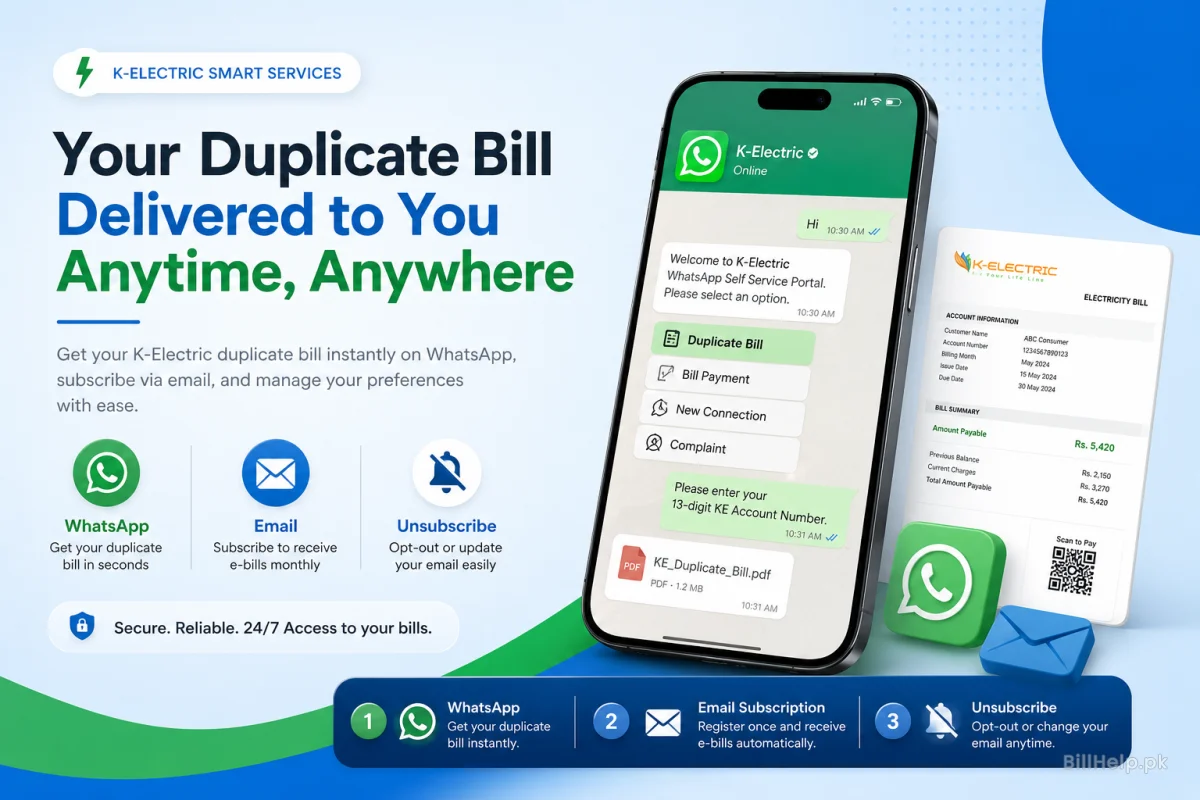
Use the BillHelp K-Electric Duplicate Bill Tool and view bill charges and payment due dates for the current bill, free of charge.
Pay Bills Online
Pay instantly using credit cards, debit cards, or mobile wallets via the K-Electric Digital Bills & Payments Portal.
Official KE Live App
Download the app for Android on Google Play or iPhone on App Store.
Learn how to read your bill statement details on the K-Electric Know Your Bill Page.