Understanding Daily Water Supply Timings in Lahore
WASA Lahore regulates the extraction of groundwater and provides clean water efficiently by operating tubewells in morning, afternoon and evening shifts in all residential areas.
The Water and Sanitation Agency Lahore (WASA) is an agency established under the Lahore Development Authority Act, 1975 to provide potable water, sewerage and urban drainage services in the metropolis. Providing 24/7 continuous municipal water supply to a population density of over 13 million people by gravity or line pressure is a complex logistical challenge. Thus, WASA has a scheduled intermittent supply system by heavy duty underground tubewell pumps at strategic locations throughout the city.
Understanding these schedules helps residents plan household chores improve home water storage systems and avoid pump runs that can damage domestic water booster systems. Water distribution times are set carefully based on peak demand hours, seasonal temperature changes, groundwater table shifts and grid load-shedding schedules that work with the Lahore Electric Supply Company (LESCO).
By default WASA pumping machinery takes water into the trunk distribution lines during three dedicated operating windows each day. In those windows pressure builds up inside the municipal pipeline network pushing water into ground-level domestic storage tanks and meter connections across residential areas.
Infrastructure & Zonal Distribution WASA Lahore
The big municipal water network of Lahore is divided into different operational zones and is managed by different Executive Engineers (EXENs), Sub-Divisional Officers (SDOs) and field staff. Knowing the zone you are in is useful when reporting local tubewell outages, pipe leakages or scheduling concerns.
The city’s supply system is almost entirely dependent upon extraction of groundwater from the alluvial aquifers recharged by the Ravi River basin. Water is pumped from depths of between 400 and 700 feet to reach clean, naturally filtered layers of water and is injected directly into the distribution grid, often treated with inline chlorination dosing for biological safety.
Zone 1 & 2 (Ravi & Shalimar)
It includes Northern and Central Lahore Old Walled City, Shadbagh, Baghbanpura, Misri Shah and nearby densely populated urban settlements.
Zone 3 & 4 (Gullberg & Samanabad)
Gulberg, Ichhra, Samanabad, Iqbal Town, Garden Town, Mozang and Central commercial and residential corridors.
Zone 5 & 6 (Gajjumata & Nishter)
Covers Southern expansion corridors, Township, Green Town, Johar Town, Faisal Town, and adjacent housing developments.
Each zone contains dozens of localized sub-divisions. When WASA issues schedule adjustments or conducts maintenance, updates are dispatched on a divisional level. Residents can identify their zonal authority directly through the introductory section of their monthly WASA bill statement.
Standard Daily Water Supply Timings
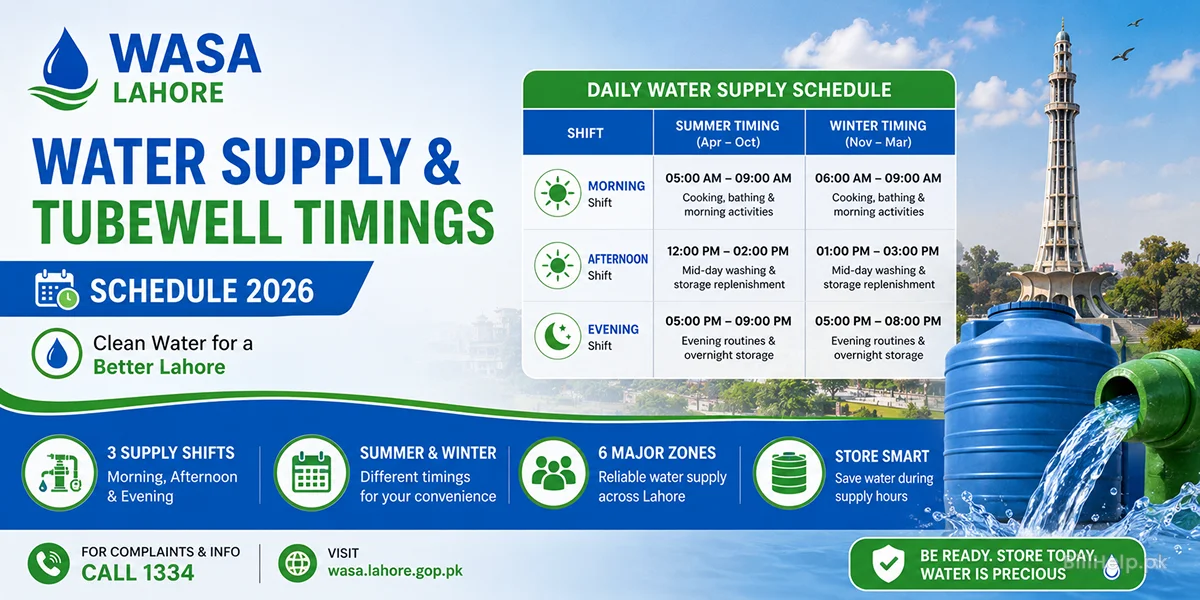
Water supply timings are divided into three standard shifts throughout the day. Shifts are a little different in summer and winter:
| Shift | Summer Timing (Apr – Oct) | Winter Timing (Nov – Mar) | Purpose |
|---|---|---|---|
| Morning Shift | 05:00 AM – 09:00 AM | 06:00 AM – 09:00 AM | Cooking, bathing, morning household activities |
| Afternoon Shift | 12:00 PM – 02:00 PM | 01:00 PM – 03:00 PM | Mid-day washing & storage replenishment |
| Evening Shift | 05:00 PM – 09:00 PM | 05:00 PM – 08:00 PM | Evening routines & overnight storage |
Shift-wise Breakdown of Operation
1. Morning Operational Window: This is the largest and highest volume supply shift in the day. During the summer months tubewells are energized as early as 5.00 AM to cater to early morning religious observances, school preparation and morning work schedules. The maximum line pressure is typically achieved 30 to 45 minutes after the pumps are started with line air pressure being vented from the distribution main grid.
2. Afternoon Operational Window: The afternoon shift is an interim replenishment window that provides a critical 2 hour window. This operational period is purposely designed to enable households to refill tanks used for morning chores and to cater for afternoon prayers and lunch preparation. This is especially true during the hot summer months, when temperatures lead to a large spike in water use.
3. Evening Operational Window: Working during peak domestic return hours, the evening shift makes sure families coming home from schools, offices and businesses have enough running water to prepare dinner, do domestic cleaning and store for the nite. Tubewells are run till 8:00 PM or 9:00 PM so that the overhead tanks can be topped up for overnight utility.
Special Ramadan and Holiday Operations Schedule
The pattern of domestic water consumption changes drastically across Lahore during the Holy Month of Ramadan. WASA changes tubewell timings for Suhoor and Iftar.
Revised Ramadan Timings Framework
Suhoor Shift ensures water pressure for food preparation, washing and ablution before dawn prayers.
Mid-day Shift is adjusted to support Zuhr prayer routines and domestic sanitation tasks.
Extended evening run time providing maximum pressure during meal prep, Iftar, and night prayers.
Special extended hours are also enacted during holidays such as Eid-ul-Fitr and Eid-ul-Adha. During Eid-ul-Adha in particular WASA tubewells run on operational shifts alongside specialized emergency sanitation teams to ensure water remains continuously available, for offal disposal and street washing protocols.
Tubewell Operations and Power Failures
WASA has more than 600 heavy tubewells in Lahore. Sometimes LESCO’s power load-shedding can disturb the supply schedules. Here's how WASA handles tubewell operations during electricity downtime:
Back-Up Generators
Major tubewell stations have heavy diesel generators to ensure water supply in case of power failure. However, due to fuel constraints and emergency maintenance, there may be occasional short, localized delays.
Low Pressure Zones
Properties located at line ends or high elevations may experience reduced water pressure during peak usage hours when demand across the network reaches its absolute maximum.
When LESCO carries out scheduled feeder maintenance or emergency tripping occurs at grid stations, tubewells on affected electrical feeders lose power immediately. While critical tubewells are linked to dual electrical feeders or backed up by industrial diesel power units, secondary neighborhood tubewells may experience temporary interruptions.
Furthermore, when power is restored after a blackout, it takes 15 to 30 minutes for line pressure to rebuild completely across long distribution mains. Homes at the tail-ends of supply lines will have a large lag in water flow compared to houses immediately adjacent to the tubewell station.
What Causes Low Water Pressure & How to Fix It
Urban consumers are frustrated by the little if any water pressure during official supply hours. The root cause is useful in selecting the appropriate corrective action:
| Problem Found | Probable Cause | Recommended Solution |
|---|---|---|
| Water reaches ground floor only | Municipal line pressure is limited to 15-20 PSI, intended for underground storage tanks. | Install an underground water storage tank paired with a automatic domestic transfer pump to lift water to overhead roof tanks. |
| Water flow is muddy/turbid | Vacuum creation in broken pipes drawing nearby soil or sewage during power outages. | Let the line flush for 10-15 minutes into a drain. Report persistent turbid water immediately to WASA helpline 1334. |
| Complete loss of supply | Main line burst, tubewell motor burn-out, or local grid feeder tripping. | Check with immediate neighbors. If widespread, log a group complaint with your zonal SDO office. |
| Gradual pressure drop over months | Scaling, rust buildup, or root intrusion in aging service connection pipes. | Inspect and clear service connection lines from the main saddle valve to your boundary wall. |
Legal Warning on Suction Pumps:
Installing direct inline suction pumps ("donkey pumps") straight onto the primary WASA supply line is strictly illegal under Punjab Water Authority regulations. Suction directly creates a vacuum in the municipal mains, drawing in the contaminated underground water from the nearby sewer lines, and severely depriving the neighboring houses of the basic supply pressure. WASA’s enforcement teams conduct surprise inspection drives and confiscate direct suction equipment, besides imposing heavy fines.
How to Call an Emergency Water Tanker Service
If you face long term water shortage in your area due to pipeline repairs, motor burn-out or tubewell maintenance, you can apply for a WASA emergency water tanker:
- Call WASA Helpline 1334 or visit your nearest Zonal Water Office in person.
- Provide your 8-digit WASA Account Code (found on your consumer water bill) with your full residential address and mobile phone number.
- Specify the source of distress (e.g. breakdown of tubewell motor, contamination of line, long time low pressure)
- Get your official Complaint Tracking Ticket Number via SMS for tracking the status.
- Depending on availability in the queue and zonal priority, an emergency water tanker will be sent to your location.
Water Tanker Pricing & Official Operational Norms
WASA provides emergency water tanker services under two separate operational categories:
- Free Dispatches: Provided when water supply is completely suspended in a localized area for more than 24 hours due to official WASA development work, pipe construction, or tubewell replacement operations.
- Paid Dispatches: If a household requests a special tanker for reasons such as empty internal storage or localized plumbing issues, while neighborhood line pressure is still functioning normally, the standard official delivery charges apply (typically ranging from PKR 1,000 to PKR 2,500 depending on the tanker’s gallon capacity and the transit distance).
Water Conservation & Quality Safety Rules
Lahore’s underground water table is depleted at an alarming rate of around 1 to 1.5 meters per year because of over-extraction and excessive urban urbanization. "It is vital to develop water conservation practices for the future water supply of the city.”
Quality and Safety Tips
- Always boil municipal water for at least 3-5 minutes before drinking or cooking.
- Install Reverse Osmosis (RO) systems or multi-stage water purifiers for drinking water purification.
- To prevent bacteria growth, empty out your home’s underground storage tanks every six months.
- Test home water quality annually for dissolved solids (TDS) and microbial safety.
Everyday Conservation Hacks
- Never wash driveways or vehicles using direct running hosepipes; use buckets instead.
- Fix leaking taps, running toilets and faulty float valves in over head tank immediately.
- Install water-saving aerators on kitchen and bathroom faucets to reduce flow rates by 40%.
- Turn off running taps when brushing your teeth or shaving.
WASA Bills & Services | What You Need to Know
WASA Lahore levies charges for residential and commercial properties on the basis of built-up plot area (unmetered flat tariff) or actual volumetric consumption (metered connections) Keeping your payment history up will help you avoid having your service disconnected and ensure you maintain uninterrupted utility service.
Main Characteristics of Modern Wasa Services:
- Duplicate Bill Downloads: Consumers can view and download duplicate water and sewerage bills online by providing their 8 digit Account Code at the official portal (
wasa.lahore.gop.pk). - Digital Payments: Payments can be made electronically via 1Bill, Internet Banking apps, Easypaisa, JazzCash or at any official bank branch counter in Pakistan.
- New Connection Requests: New water and sewerage connection requests, connection size upgrades or commercial conversions can be submitted at WASA One-Window Operation Centers at each zonal headquarters.
- Customer Support: Complaints related to wrong billing tariff classification, meter readings or water contamination can be made directly through WASA Lahore Helpline 1334 or Chief Minister’s Punjab Portal.
Frequently Asked Questions
wasa.lahore.gop.pk), navigate to the duplicate bill section, and enter your 8-digit Account Code printed on previous bill statements to view and print your bill.