Have you ever opened your monthly Sui Southern Gas Company (SSGC) bill statement, looked at the total payable amount, and wondered why the charges are unexpectedly high? For millions of households across Sindh and Balochistan, deciphering utility bills can feel like reading a complex financial document. Between volumetric gas consumption charges, tiered pricing slabs, fixed meter rents, and various government levies, understanding how your bill is calculated is essential for effective household budgeting.
In this comprehensive guide, we will break down every single term, code, and calculation on your SSGC bill statement in clear English. By mastering how gas tariffs work and learning how consumption volumes shift across protected and non-protected brackets, you can take proactive steps to monitor your energy usage and avoid shocking bills during peak winter seasons.
1. Anatomy of an SSGC Bill: Front Side vs. Back Side
Your official SSGC paper or digital e-bill is divided into two content-rich sides packed with crucial consumer data:
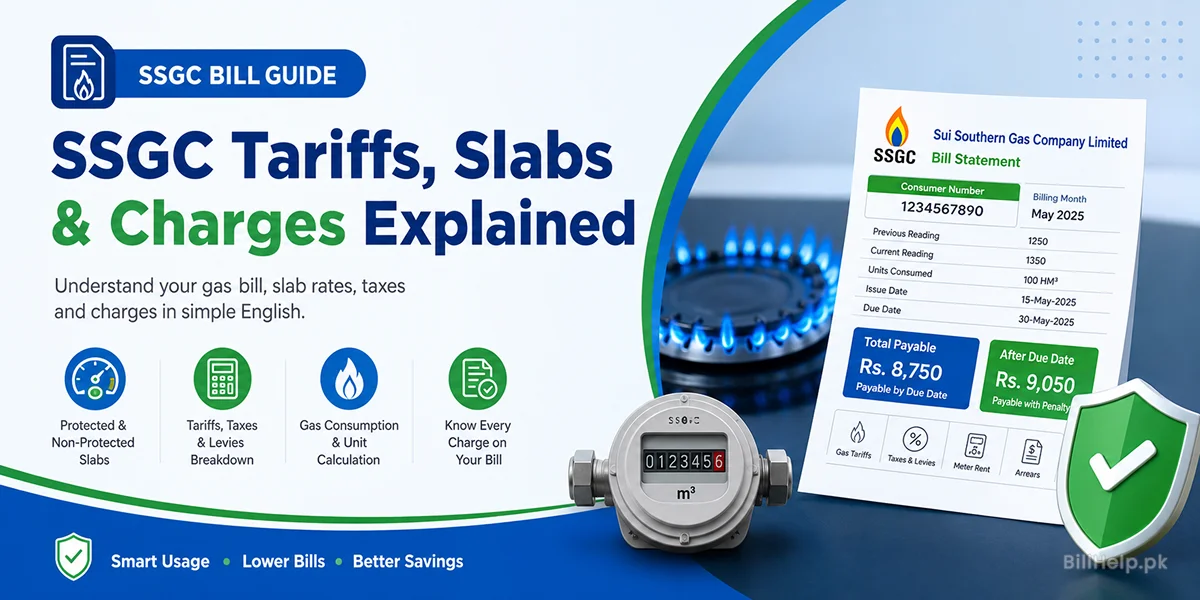
- The Front Side: This is the primary operational dashboard of your bill. It displays your unique 10-digit consumer number, meter serial number, previous and current meter readings, total units consumed during the billing cycle, billing month, issue date, due date, payable amount before the due date, and a separate penalty amount payable after the due date.
- The Back Side: This section contains regulatory information, authorized bank payment codes and branch networks, safety guidelines regarding natural gas usage, office addresses of regional customer facilitation centers, and emergency helpline contact numbers.
2. Understanding Gas Slabs: Protected vs. Non-Protected Consumers
Natural gas tariffs in Pakistan are governed by progressive pricing slabs established by the Oil and Gas Regulatory Authority (OGRA). To protect low-income households from inflationary pressures, domestic consumers are officially categorized into two distinct groups:
| Consumer Category | Monthly Gas Consumption Limit | Tariff Rate Structure |
|---|---|---|
| Protected Consumers | Up to 0.9 HM³ (Hectometer cubic or specific low volume thresholds) | Significantly lower, highly subsidized slab rates designed for economical users. |
| Non-Protected Consumers | Exceeding 0.9 HM³ per month | Higher progressive commercial and standard slab rates that scale upward with consumption. |
When winter arrives and households begin utilizing heavy appliances like gas geysers, room heaters, and large cooking ranges, monthly consumption volumes surge. This sudden spike frequently pushes consumers out of the subsidized 'protected' bracket into higher 'non-protected' slabs, causing bills to multiply exponentially.
3. Deconstructing Fixed Charges, Taxes, and Levies
Beyond the actual thermal cost of the natural gas you burn in your appliances, your bill includes several mandatory government taxes and fixed operational utility fees:
- General Sales Tax (GST): A mandatory government tax calculated as a fixed percentage of your total gas consumption cost and service charges.
- Gas Infrastructure Development Cess (GIDC): Levies applied to support national gas pipeline infrastructure development and imported LNG balancing pools.
- Meter Rent & Service Charges: A nominal fixed monthly fee charged by SSGC for maintaining, calibrating, and servicing the physical gas meter installed at your property.
- Arrears / Previous Balances: Any unpaid amounts carried forward from past billing cycles, including any late payment surcharges incurred from previous delayed clearances.
4. How SSGC Measures and Calculates Consumption Units
Your physical gas meter measures gas volume in cubic meters (m³). However, billing is assessed on thermal energy content (measured in HM³ or MMBTU). SSGC technicians apply specific pressure correction and calorific value factors to convert physical volume into standardized billing units.
Understanding this conversion helps explain why minor fluctuations in weather temperature and gas pressure can slightly alter thermal heating values from month to month.