Explanation of WASA Lahore Tariff System
WASA Lahore bills monthly on the basis of property size, type of connection (metered or unmetered) and type of usage (residential or commercial). This knowledge of rates helps consumers to calculate their bills correctly and avoid being overcharged.
The Water and Sanitation Agency (WASA) is a subsidiary of Lahore Development Authority (LDA) and provides safe drinking water to Lahore, operates the city’s sewage system and maintains the city’s storm-water drains. Managing public water infrastructure for millions of residents requires a complex administrative and operational blueprint. To fund tubewell extraction, filtration plants, main-line pipe maintenance and wastewater treatment, WASA employs a tiered municipal tariff structure governed by strict provincial regulatory guidelines.
For decades, the foundation of urban water management in Lahore has operated on a dual mechanism: assessed unmetered tariffs based on physical property dimensions versus volumetric metered billing. Understanding which category your property falls under—and how specific surcharges interact with your baseline consumption—is essential for keeping household operating budgets predictable and verifying that billing line items correspond to legitimate municipal codes.
Your WASA Bill: Important Elements
- Water Supply Charges: Charges for clean water to your property. Calculated either via volumetric meter readings (in gallons/liters) or assessed based on plot area and multi-story covered space.
- Sewerage Charges: Fee for maintaining drainage and sewage treatment. This line item offsets the municipal costs of operating sewer vacuum trucks, clearing underground mains and pumping runoff out of low-lying urban sectors.
- Aquifer Charges: Applicable for commercial or heavy extraction users. Imposed by mandate on private tubewells, housing schemes, commercial bottling facilities and large complexes drawing groundwater directly from the underlying water table the Water Bill must be paid by all users.
- Fixed / Service Charges: This portion of the Water Bill covers meter maintenance and baseline administrative fees. Involves maintenance of customer records, calibration checks of meters, printing of invoices and integration of digital payment gateways.
- Arrears & Surcharges: If previous invoices of the Water Bill were unpaid past the date penalty amounts are added. In addition statutory municipal taxes levied by regulatory authorities are included in the Water Bill.
Jurisdictional Scope
WASA Lahore governs municipal billing in major urban zones including Gulberg, Samanabad, Ravi Town, Shalimar Town, Nishter Town, Data Gunj Bakhsh Town, Iqbal Town and Allama Iqbal Town. Private housing societies like DHA or Bahria Town operate separate, private utility structures.
Assessment Criteria
Unmetered property assessments evaluate plot area measured in Marlas or Kanals, the number of storeys constructed, presence of commercial activity on the ground floor, and whether the water connection is active, seasonal or temporarily suspended.
Because municipal groundwater levels in Lahore face ecological stress, tariff policies have gradually shifted to incentivize conservation. Residential users who monitor their consumption patterns and understand how their monthly billing statement is structured are better equipped to identify billing errors early, request official inspector audits, and transition toward metered connections where cost benefits exist.
WASA Lahore Residential Tariff Rates
Residential tariffs in Lahore are categorized by plot size for unmetered connections. Here is an outline of residential rates:
| Property Category | Plot Area (Marla / Kanal) | Unmetered Monthly Rate (Approx) | Sewerage Fee Share |
|---|---|---|---|
| Small Housing | Up to 3 Marla | Economy Rate | Included / Standard percentage |
| 5-Marla Residential | 5 Marla (Standard) | Mid-Tier Fixed Rate | Standard Water + Sewerage |
| Medium Housing | 7 to 10 Marla | Standard Rate | Proportional to plot size |
| Large Housing | 1 Kanal and above | Higher Tier Rate | Full Sewerage & Service Charge |
*Note: Rates are subject to official WASA government notifications and municipal adjustments.*
Detailed Comparative Breakdown Across Residential Property Scales
To provide a broader perspective on how property sizing directly impacts municipal billing obligations, consider the expanded breakdown below. Unmetered rates scale according to land footprint and structural density because larger properties generally harbor larger households, multiple bath fixtures, lawns or high-capacity suction pumps.
| Plot Dimensions | Approx. Covered Area Baseline | Water Supply Ratio | Sewerage Surcharge Ratio | Billing Cycle Frequency |
|---|---|---|---|---|
| 2 - 3.5 Marla | Under 800 sq ft | Baseline Subsidized Rate | 30% of Baseline Water Rate | Bi-Monthly / Monthly |
| 5 Marla (Standard) | 1,125 - 1,350 sq ft | Mid-Tier Assessed Rate | 35% - 40% of Base Rate | Monthly |
| 7 - 10 Marla | 1,500 - 2,250 sq ft | Standard Municipal Tier | 40% - 45% of Base Rate | Monthly |
| 12 - 15 Marla | 2,700 - 3,375 sq ft | Upper-Mid Tier Assessment | 50% of Base Rate | Monthly |
| 1 Kanal | 4,500 sq ft | Premium Fixed Tier | 50% - 60% of Base Rate | Monthly |
| 2 Kanal + | 9,000+ sq ft | Maximum Unmetered Tier | Full Standard Surcharge Tier | Monthly |
Understanding Commercial Surcharges on Residential Units
If a residential property operates a shop, clinic, beauty parlor, day-care center or home office on the ground floor, WASA revenue inspectors reclassify the entire connection—or apply a proportional commercial multiplier—to the baseline unmetered bill. Commercial rates reflect higher volumetric consumption and significantly increased wastewater production.
How a 5-Marla WASA Bill is Calculated
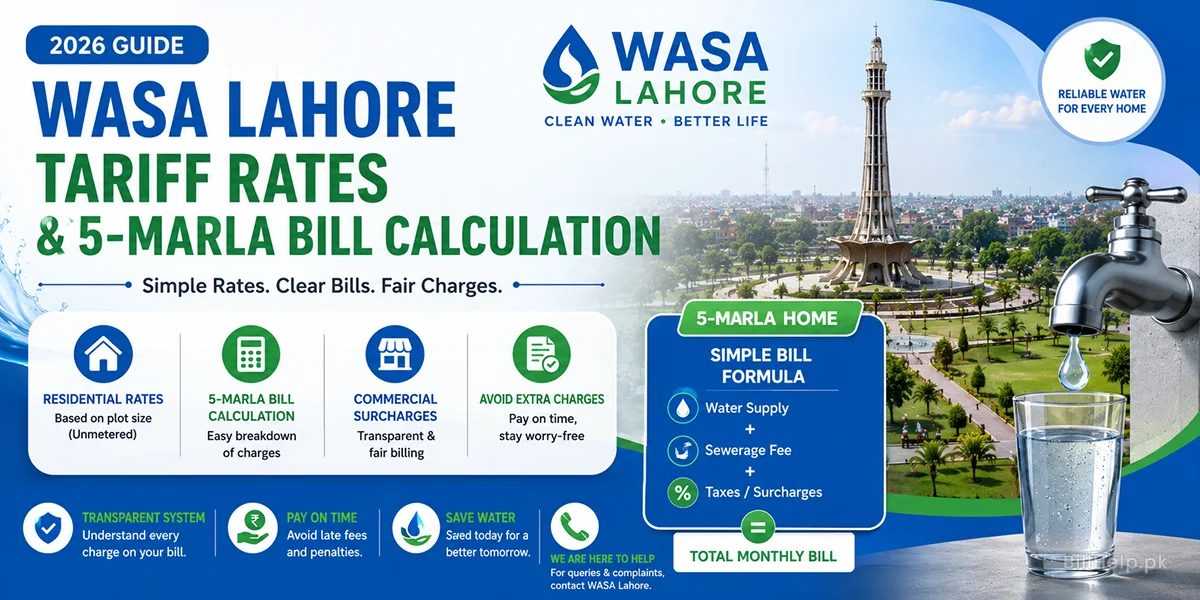
5-marla homes represent a large portion of residential connections in Lahore. Here is how a standard 5‑marla unmetered Water Bill is structured:
Formula for Unmetered Connections
Total Monthly Bill = Base Water Charge + Sewerage Fee + Taxes/Surcharge.
1. Water Supply Base
Fixed monthly or yearly charges based on covered area and plot size (5 Marla). Derived from municipal property records relative to standard tables of land classification.
2. Sewerage Ratio
Calculated as a fixed percentage (typically 30%–50%) of the total water supply charge. Offsets ongoing municipal drainage maintenance and main-line maintenance.
Sample Calculation – Step By Step Standard 5 Marla House
To clearly demonstrate how these numbers come together on an actual WASA paper or digital bill, let us break down a hypothetical monthly billing cycle for a standard 5-Marla double-story residential house in Lahore.
Sample Calculation Breakdown (5-Marla Unmetered Connection)
- Assessed Base Water Rate (5-Marla Category):PKR 350.00
- Sewerage Charge (Assumed at 40% of Base Water Rate):PKR 140.00
- Fixed Service / Administrative Surcharge:PKR 30.00
- Multi-Story Addition (if applicable for 2nd Storey):PKR 80.00
- Subtotal Current Charges:PKR 600.00
- Late Payment Surcharge (if paid past due date ~10%):+ PKR 60.00
- Total Payable Within Due Date:PKR 600.00
Metered Consumption Billing Mechanics
When a water meter is installed, the unmetered fixed property assessment is replaced by volumetric billing. In volumetric billing, consumption is logged in units of 1,000 gallons (or cubic meters). Below is an overview of how volumetric tiers operate for metered residential consumers:
| Monthly Consumption Bracket | Rate per 1,000 Gallons (Assessed) | Sewerage Multiplier | Consumer Guidance Tip |
|---|---|---|---|
| Up to 5,000 Gallons | Tier 1 (Subsidized Lifeline) | Standard Low Ratio | Ideal for small 5-marla families conserving water. |
| 5,001 to 10,000 Gallons | Tier 2 (Standard Rate) | Standard Household Ratio | Average consumption for a 4–6 member household. |
| 10,001 to 20,000 Gallons | Tier 3 (Upper Middle) | Proportional Increase | Occurs with lawns, frequent car washing, or large tanks. |
| Above 20,000 Gallons | Tier 4 (High Volume Rate) | Full Sewerage Charge | Highest cost bracket; inspect for subterranean pipe leaks. |
The choice between metered and unmetered billing is largely a matter of household size and usage habits. A small family living in a 5-marla house, and who uses water judiciously, can save a lot by asking for a metered connection. In contrast, the standard unmetered property rates could be less expensive for large joint-family units with high water usage per day.
How to Dispute Overbilling or Incorrect Rates
If you feel your WASA bill has been wrongly computed or has overcharges greater than the size of your property, here’s what to do:
Check Property Category
Make sure your bill reflects the proper plot area (e.g. 5 Marla instead of 10 Marla). Check the story count and commercial flags are correct.
Collect Documentation
Keep ready property ownership papers, CNIC, last paid receipts. Exterior photos of the property are helpful, too.
Submit Application
Visit your WASA Revenue Office or lodge an application on the WASA online complaint portal. Obtain a tracking ticket number.
Comprehensive Correction & Appeal Roadmap
Billing discrepancies often occur due to incorrect municipal reclassifications, typographical errors in consumer records or mistaken commercial tags. Here’s a longer guide to working your way through the dispute process like a pro:
Documentation Checklist Required for Correction Applications
- Attested Copy of CNIC: National Identity Card of the property owner/registered account holder.
- Proof of Property Ownership: Allotment letter, registry paper or excise property tax record with exact measurement of plot (for example 5 Marla).
- Recent Paid WASA Bills: Copies of last 3-6 months paid bills with clean payment history.
- Photographic Evidence: Clear photographs of the front of the House Structure in case of a dispute on the number of storeys or property category.
- Application Letter: To The Deputy Director Revenue (DDR) of your respective WASA division.
- Site Inspection Verification Report: Form issued after a WASA inspector verifies physical site conditions.
Locating Your Concerned WASA Revenue Office
WASA Lahore is decentralized into specialized administrative towns. When filing a physical appeal, ensure you present your file at the office matching your consumer account number prefix:
| Town Division | Key Areas Covered | Primary Administrative Jurisdiction |
|---|---|---|
| Gulberg Town | Gulberg I-V, Model Town sub-sectors, Garden Town | Sub-Divisional Revenue Office Gulberg |
| Iqbal Town | Allama Iqbal Town, Sabzazar, Wahdat Colony | Sub-Divisional Revenue Office Iqbal Town |
| Samanabad Town | Samanabad, Ichhra, Gulshan-e-Ravi | Sub-Divisional Revenue Office Samanabad |
| Ravi / Data Town | Walled City, Shadbagh, Misri Shah, Krishan Nagar | Sub-Divisional Revenue Office Northern Zone |
| Nishter / Shalimar Town | Baghbanpura, Mughalpura, Township, Green Town | Sub-Divisional Revenue Office Eastern Zone |
Frequently Asked Questions
wasa.lahore.gop.pk). Simply enter your 8-digit or 10-digit Account Number / Consumer ID printed on previous bills to view current charges, payment history and print an original duplicate bill for bank payment.