Wasa Lahore New Connection Apply Process
If you are building a new house or opening a commercial shop in Lahore, you need to have an official WASA water supply and sewerage connection as per the municipal law.
Residential Connections
For private houses and apartments and residential buildings on the basis of plot marla size.
Commercial Connections
Shops, plazas, offices, service stations, industrial units.
What is WASA Lahore and what is its role in city utilities?
The Water and Sanitation Agency (WASA) is a core subsidiary of the Lahore Development Authority (LDA) responsible for providing clean drinking water, underground wastewater channels management and drainage infrastructure management in the metropolitan region of Lahore. WASA, created under the Punjab Development of Cities Act, operates a vast network of tube wells, water storage reservoirs, overhead tanks and underground pipelines that provide millions of gallons of potable water daily to residential, commercial and industrial consumers.
Having a legal water and sewerage connection is a legal requirement for property owners and protects public health and municipal infrastructure. Uncontrolled connections result in serious problems such as disruption of the hydraulic pressure of the system, cross-connections resulting in water contamination and depletion of groundwater reserves without the necessary regulatory oversight. Registering your connection with WASA Lahore officially will not only give you access to safe municipal water but will also meet your legal responsibilities as a citizen.
I have seen how WASA splits its distribution network into sub‑divisions and towns across Lahore. This includes Nishter Town, Shalimar Town, Ravi Town, Data Gunj Bakhsh Town, Gulberg Town, Allama Iqbal Town, G stage and Samanabad Town. At every office a WASA Executive Engineer (EXEN) leads the team. The team also has WASA Sub‑Divisional Officers (SDOs) line superintendents and field inspectors. Together these people handle the processing of utility connection applications.
Required Documents Checklist
Before you visit your WASA Sub‑Divisional Office or fill out the application form online make sure you have the following documents:
- Attested copy of Applicant’s CNIC.
- Proof of property ownership such, as a Registry, Fard or Allotment Letter.
- Approved Building Site Plan (LDA or Municipal Corporation approval).
- Neighbor’s WASA bill copy (for local line verification).
- No Objection Certificate (NOC) if required for rented or shared premises.
Full Document Specifications & Validation Criteria
All documents submitted must meet WASA’s particular operational standards to prevent delay or rejection at the initial administrative screening at the Sub-Divisional Office:
CNIC Check
Copy of Computerized National Identity Card (CNIC) shall be clearly readable and attested by a Grade-17 or above gazetted government officer. If the applicant is an Overseas Pakistani, a copy of NICOP (National Identity Card for Overseas Pakistanis) with passport credentials is required.
Legalities of Ownership
Property ownership documents must clearly show an unambiguous legal chain of title. Accepted title deeds include Registered Sale Deeds (Intiqal/Registry) Fard-e-Malkiyat issued by the Revenue Department (dated within the three months) or formal Allotment Letters issued by approved housing bodies such as LDA, Punjab Housing Authority or Metropolitan Corporation Lahore (MCL).
Approved Site Plan
The site plan must include sanction stamps, from the Lahore Development Authority (LDA) or the relevant Municipal Corporation office. For -story buildings, plazas or commercial complexes the approved plan must clearly indicate the locations of water storage tanks pump rooms and internal plumbing shafts.
Neighboring Utility Bill
A copy of a WASA bill from an immediate neighbor helps the field inspection team to locate the main supply pipeline, determine the current line pressure and verify the correct Consumer ID Series and Sub-Division Code for your street.
Application Process Step by Step
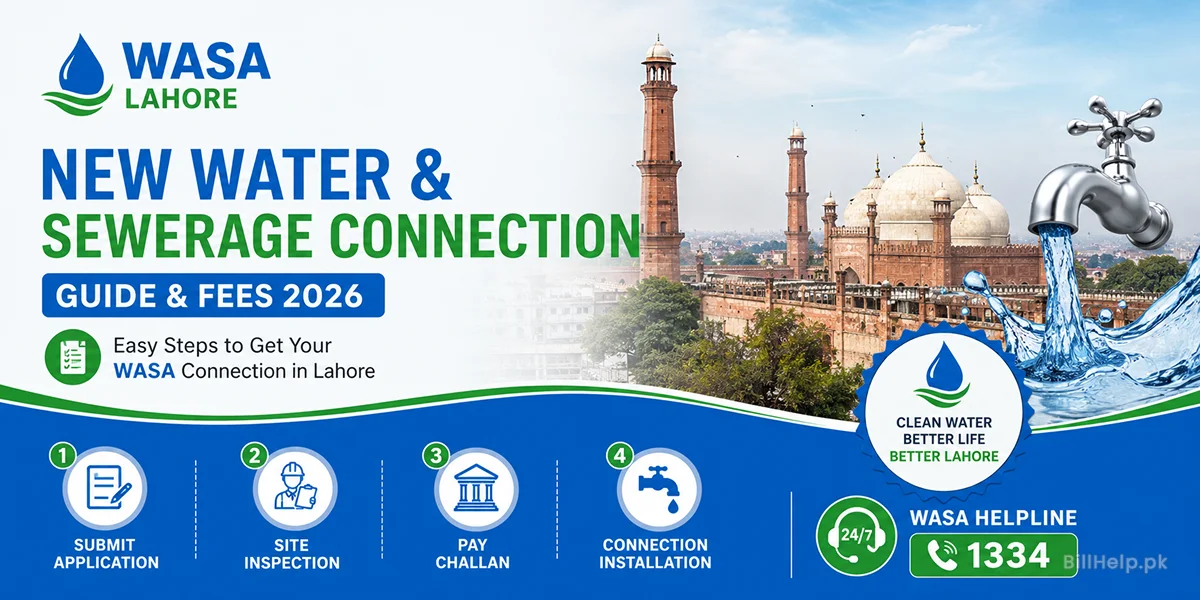
The standard process to apply for a new water connection is as follows:
Form Submission
WASA Zonal Office Get & Submit Application Form
Site Inspection
Field Inspector from WASA confirms feasibility of water main line.
Challan Payment
Pay connection fee demand notice in specified bank.
Configuration
Technical team links sewer line and water supply.
Complete Walkthrough of the Workflow
Phase 1: Application Form filling & Application Process
You can get the physical Application Form from any WASA One-Window Service Center or download the official PDF form directly from the WASA Lahore portal (wasa.lahore.gop.pk). Fill in the applicant details correctly and mention the Plot Size in Marla or Kanal, Total Covered Area, Required Connection Size (0.5 inch, 0.75 inch, 1 inch or higher) and Nature of Usage (Residential, Commercial, Industrial or Educational).
Phase 2: On-Site Engineering Survey & Feasibility Study
Once the application dossier is received, the Sub-Divisional Officer deputes a qualified field inspector to visit the property location. The inspector will look for the presence of a municipal supply line or main sewer within connection distance, the width of the street, whether you will need road cutting permissions from the local council or LDA and the precise length of pipe needed to connect the main line to the boundary of your property.
Phase 3: Issuance and Settlement of the Official Demand Notice
After a site feasibility check is finished WASA calculates the connection fee, security deposit, road restoration cost and sewer joining charges. Then WASA creates a Demand Notice, also called a Bank Challan and sends it to the applicant. The applicant must pay the amount at the listed branches of the Bank of Punjab or through the approved utility banking channels before the expiry date shown on the Demand Notice.
Phase 4: Physical Line Tapping and Meter Installation
The SDO office verifies the paid challan receipt and then issues a work order to the technical team. The field crew taps the main line, installs ferrule valves, runs connection piping to the boundary line, connects the drainage outlet to the municipal sewer trunk line and installs a calibrated water meter where applicable to tariff category.
Structure of Fee & Demand Notice
The charges for connection to WASA Lahore depend on the size of the plot, commercial classification of the plot, diameter of the pipe and the construction requirements. The charges are split into administrative charges, line connection charges, security deposits and road rehabilitation tariffs.
| Property Category / Plot Size | Connection Size | Water Supply Fee Range | Sewerage Fee Range | Security Deposit |
|---|---|---|---|---|
| Residential (Up to 5 Marla) | 0.50 Inch | Standard Base Tariff | Standard Base Tariff | Refundable Base |
| Residential (5 to 10 Marla) | 0.50 - 0.75 Inch | Mid-Tier Tariff | Mid-Tier Tariff | Standard Deposit |
| Residential (10 Marla to 1 Kanal) | 0.75 - 1.00 Inch | Higher Grade Tariff | Higher Grade Tariff | Extended Deposit |
| Residential (Above 1 Kanal) | 1.00 Inch + | Custom Technical Rate | Custom Technical Rate | High-Capacity Deposit |
| Commercial Shops / Small Plazas | 0.75 - 1.00 Inch | Commercial Multiplier | Commercial Multiplier | Commercial Deposit |
| Industrial Units / Service Stations | 1.50 Inch & Above | Industrial Bulk Rate | Industrial Bulk Rate | Industrial Security Base |
Note: Exact monetary figures are updated periodically through official notifications issued by the Government of Punjab and WASA Lahore administration. Road cutting fees vary based on whether the street surface is asphalt, concrete, or brick paving.
WASA Legal Regulations & Penalties for Unauthorized Connection
Important Legal Notice
WASA Lahore bylaws and Punjab Water Act strictly prohibit unauthorized connection or installation of direct suction pump directly on municipal mains and such acts are illegal and liable to heavy fines, legal notice and connection disconnection.
| Offense / Violation | Action / Penalty |
|---|---|
| Illegal Water or Sewer Connection | Immediate disconnection + Backdated billing + Fine |
| Direct Suction Pump on Main Line | Pump confiscation + Heavy penalty notice |
| Commercial Use on Residential Rate | Tariff conversion + Backdated commercial rate fine |
Legal enforcement system & water loss mitigation
WASA Lahore has active enforcement squads that conduct surprise audits in all urban sub-divisions. Illegal tapping is one of the major causes of non-revenue water (NRW) loss that reduces the availability of water to compliant consumers and disrupts the line pressure of the system. Regulatory authorities under Lahore Development Authority Conduct Bylaws and Punjab Water Act, have the authority to issue non-bailable warrants and initiate prosecution against persistent violators.
Key legal restrictions strictly enforced by WASA field enforcement are:
- Prohibition of Direct Online Pumps: The direct installation of electric suction pumps on WASA water lines creates a negative pressure that sucks in contaminated ground seepage into the main supply network. The property owners have to install an underground storage tank (suction tank) and pump the water from this tank to an overhead reservoir with the help of an internal pump.
- Tampering with Metering Devices: Any bypassing of water meters, breaking of mechanical seals or changing of meter readings will attract penal recovery charges equivalent to up to 24 months of maximum estimated consumption.
- Illegal Discharge of Industrial Effluent: Industrial units, commercial laundries and car wash service stations discharging untreated chemical waste or silt into WASA sewerage lines without oil-grease traps and primary treatment plants will face immediate sealing of premises and prosecution under environmental protection acts.
Water Metering and Conservation Guidelines
WASA Lahore has been implementing water metering initiatives in different residential and commercial sectors to conserve Lahore’s groundwater and promote sustainable use of water. Consumers of metered connections pay for the actual volumetric consumption and not for unmetered flat-rate tariffs related to the plot area.
Advantages of volumetric measurement
Metered billing promotes water conservation, avoids water overuse and gives consumers direct control over their monthly utility costs.
- Fair billing for actual volume used.
- Early detection of hidden internal pipe leaks.
- Households with low consumption pay less than with flat tariffs.
Conservation Good Practices
We urge consumers to take simple water conservation steps on their residential and commercial properties:
- Put flow restrictors and aerators on indoor faucets.
- Use modern sanitary wares with dual-flush systems.
- Don’t wash personal auto vehicles and paved driveways with the hose.
Guide to Transfer of Ownership & Change of Name
When buying a second hand residential property or commercial space in Lahore, it is essential to change the record of the WASA connection into the name of the new legal owner. Using a connection in the name of a former owner can cause problems when reselling a property, in legal cases or security deposit claims.
The procedure for changing connection name:
- Get a Name Change Application Form from the relevant WASA Sub-Divisional Office or get it from the internet.
- Include a copy of the new owners CNIC with two recent passport-size photos.
- Give proof of transfer by law like a signed Sale Deed, a Transfer Letter, from LDA or housing society or an Inheritance Certificate.
- Add a copy of the recent WASA bill that shows it is paid to make sure all old debts and unpaid amounts are completely settled.
- Give the papers to the SDO office. A fee slip will be. After checking the payment the name will be changed in the billing system for future bills.