How Does SNGPL Calculate Your Monthly Gas Bill
Knowing how your SNGPL gas bill is calculated can help you save money during the high consumption winter months. SNGPL has slab system for pricing and the gas rates increase with the increase in consumption. The intricacies of utility billing in Pakistan can sometimes be daunting, particularly with the seasonal tariff adjustments carried out by regulatory authorities. To be able to manage your household expenses properly, you need to know every single element that goes into the final numbers printed on your monthly statement.
The gas is measured at your meter in standard cubic meters (hm3) and converted into energy units called MMBTU (Million British Thermal Units) using the gas pressure and gross calorific value (GCV). This conversion helps to standardize the billing process . The heating quality or energy density of natural gas can vary slightly due to pipeline dynamics , source fields , and ambient temperatures . The meter reader records the volume consumed in cubic meters or hectocubic meters (hm³) when they come to your home. Subsequently, the central data processing units convert the physical volume into thermal units by applying the monthly pressure factor and GCV multiplier approved by the Oil and Gas Regulatory Authority (OGRA).
After conversion of your usage to MMBTUs it is matched against predefined consumption slabs or tiers. Unlike flat rate pricing models, SNGPL has a progressive slab structure for domestic consumers. What this means is that your entire consumption may not be charged at one rate. Different blocks of your consumption are charged at different slab thresholds. Understanding this progressive approach will help you spot any unexpected spikes in your billing statement and take corrective conservation actions early on.
Looking to get your SNGPL bill now?
For instant duplicate bill, enter your 10-digit Account ID.
Evolution of Natural Gas Distribution & SNGPL Mandate
Sui Northern Gas Pipelines Limited (SNGPL) is one of Pakistan’s largest integrated gas utility companies. It provides natural gas to millions of residential, commercial and industrial consumers in Punjab and Khyber Pakhtunkhwa. It was established to regulate transmission, distribution and sales and operates a huge network of high-pressure pipelines that span thousands of kilometers.
Demand pressures are mounting and supply chain issues with natural gas reserves have led to tighter regulation. OGRA regularly revises the tariffs in view of the international market trends, local inflation, currency devaluation and weighted average cost of gas (WACOG). Thus, keeping abreast of current tariff structures is no longer a luxury for prudent household budgeting, but a fundamental necessity of financial management.
SNGPL Domestic Gas Tariff Slabs (Protected vs Non-Protected)
SNGPL has classified domestic consumers into two major categories:
- Protected Consumers: Low usage consumers that consume less than 0.9 hm³ per month during winter peak months. They enjoy the benefit of heavily subsidized rates to shield lower income households from the soaring cost of fuel.
- Non-Protected Consumers: Consumers who consume more than 0.9 thousand cubic meters per month. The households are charged higher slabs on a progressive scale corresponding to the actual cost of supply.
The line between protected and non-protected status is an extremely important one. The household is entitled to the protected status, if the average monthly consumption in the winter months of the previous year does not exceed the threshold of 0.9 hm3. However, one winter consumption spike that exceeds this threshold can downgrade the consumer to the non-protected category, which would result in a large increase in unit prices for all subsequent billing cycles until reassessment.
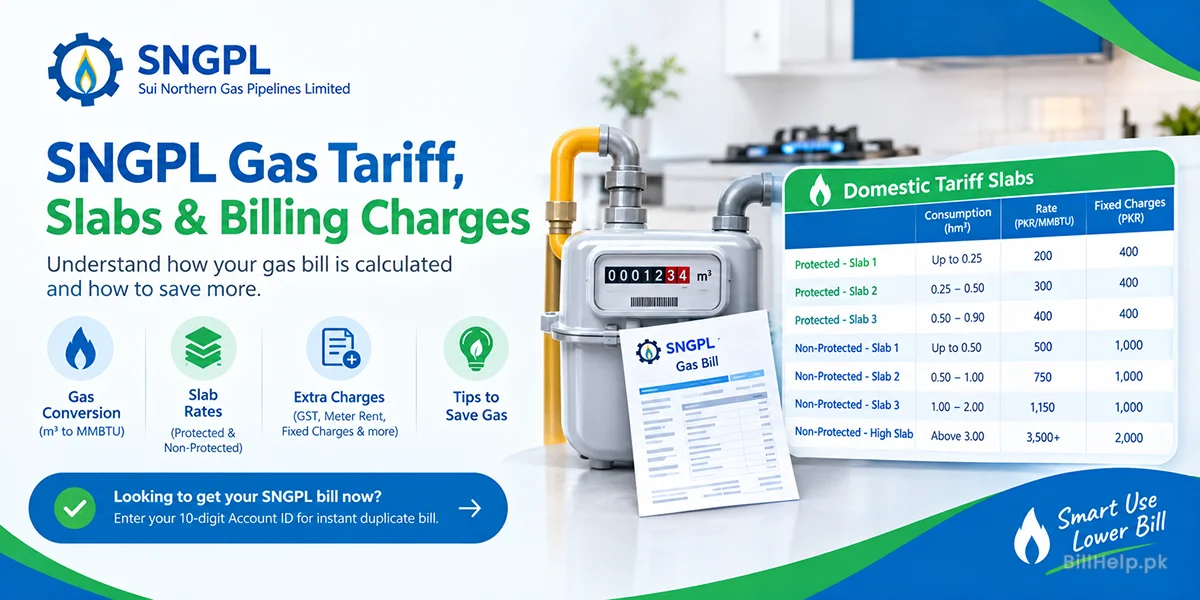
| Category / Slab | Monthly Consumption Range (hm³) | Gas Rate per MMBTU (PKR) | Fixed Charges (PKR) |
|---|---|---|---|
| Protected - Slab 1 | Up to 0.25 hm³ | Rs. 200 / MMBTU | Rs. 400 |
| Protected - Slab 2 | 0.25 - 0.50 hm³ | Rs. 300 / MMBTU | Rs. 400 |
| Protected - Slab 3 | 0.50 - 0.90 hm³ | Rs. 400 / MMBTU | Rs. 400 |
| Non-Protected - Slab 1 | Up to 0.50 hm³ | Rs. 500 / MMBTU | Rs. 1,000 |
| Non-Protected - Slab 2 | 0.50 - 1.00 hm³ | Rs. 750 / MMBTU | Rs. 1,000 |
| Non-Protected - Slab 3 | 1.00 - 2.00 hm³ | Rs. 1,150 / MMBTU | Rs. 1,000 |
| Non-Protected - High Slab | Above 3.00 hm³ | Rs. 3,500+ / MMBTU | Rs. 2,000 |
*Note: Tariff rates are determined by OGRA (Oil & Gas Regulatory Authority) and subject to official updates.
Detailed Breakdown of Additional Bill Taxes & Terminology
When analyzing your gas bill, looking solely at the cost of consumed gas will often lead to confusion because various government levies, fixed tariffs, and service rents are appended to the total sum. Now we shall consider each of these factors in exact detail:
1. Fixed Charges
OGRA fixed service charge applicable as per consumer category regardless of gas consumption. These fees go toward ongoing infrastructure maintenance, network monitoring and system upgrades even in months where your consumption is low.
2. Meter Rent
Meter Rent is a monthly fee, such as Rs. 40 To Rs. 50 Which is charged for the upkeep and inspection of the gas meter. Meter Rent covers calibration, safety checks and the eventual replacement of worn‑out mechanical or digital metering equipment.
3. General Sales Tax (GST)
General Sales Tax (GST) is a government sales tax applied at the rate on the total gas cost. General Sales Tax (GST) is collected directly by the federal revenue authorities. General Sales Tax (GST) makes up a part of the variable charges on the utility bill.
4. Rebate / Price Adjustment
Prior adjustments credited or debited due to meter correction, meter lock periods, or previous over-billing. If a previous bill was estimated incorrectly due to an inaccessible meter, subsequent physical readings trigger an automated adjustment balance.
Additional Surcharges and Gas Infrastructure Development Cess (GIDC)
In certain commercial or high-tier domestic brackets, additional surcharges such as the Gas Infrastructure Development Cess or special federal levies may appear. These are designed to fund strategic cross-border pipeline projects, liquefied natural gas (LNG) terminal integration, and security infrastructure safeguarding energy transmission lines across difficult terrain.
Tips to Reduce Your SNGPL Gas Bill
With rising energy tariffs it is essential to adopt practical conservation strategies to keep utility costs under control. Small changes in habits can lead to noticeable savings, on the winter bill.
- Optimize Water Heating: Geysers use a lot of gas. When they are not being used turn off instant or storage geysers. Use timer switches to heat water only during the needed morning and evening times.
- Save Time in the Kitchen: Boil pulses and tough meats in pressure cookers to reduce cooking time by half. For best results keep pot lids closed while simmering.
- Inspect Appliances for Gas Leaks: Bad burners or leaking valves are not risky but also waste valuable fuel and raise your monthly usage amount.
- Insulate Living Spaces: Make sure doors and windows are properly sealed during the winter months to stop heat from escaping, which reduces the need, for extra room gas heaters.