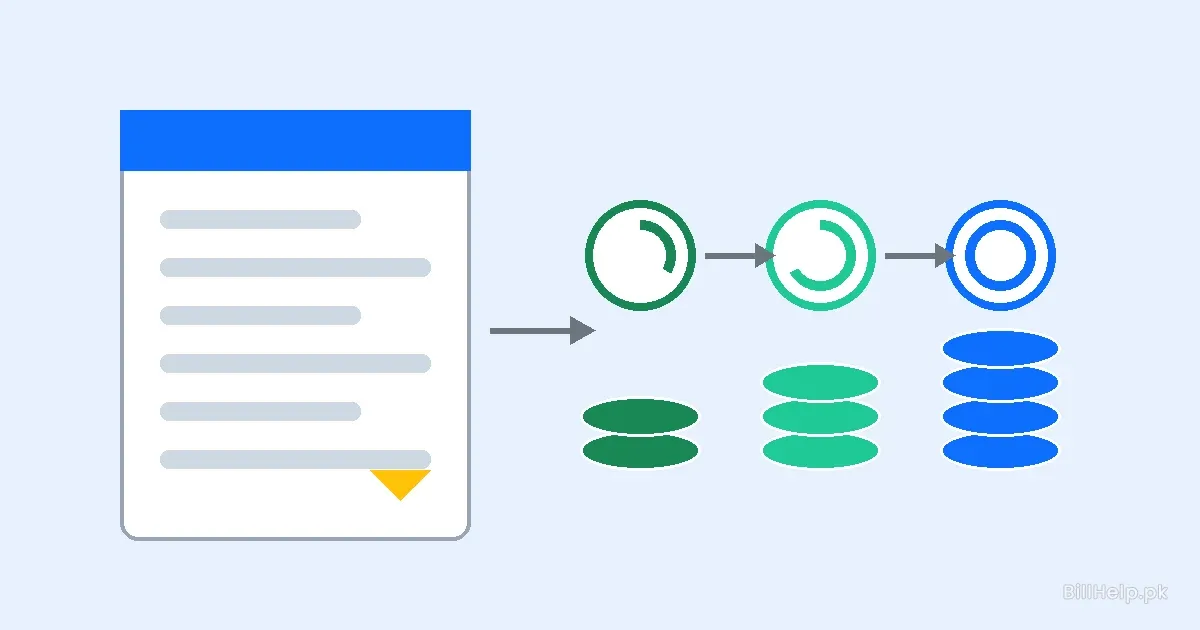
Quick answer: Yes. Every electricity company in Pakistan works under NEPRA's Consumer Service Manual, and it allows bills to be paid in installments. Ask your company's local office before the due date. If the first installment is paid on time, there is no late payment surcharge on it. The rest carries markup of 14% a year.
This guide covers IESCO, LESCO, MEPCO, FESCO, GEPCO, PESCO, HESCO, SEPCO, QESCO, TESCO, HAZECO and K-Electric.
A heavy bill does not have to mean a cut connection. The national rules give you a way to split it. But each company runs the process through its own offices, and many people go to the wrong desk or go too late. Below, each question gets a short answer first, then the detail.
Can I pay my electricity bill in installments?
Short answer: Yes, if your company allows it in your case. It is a facility, not an automatic right.
NEPRA's Consumer Service Manual (CSM), revised in November 2025, was sent to all distribution companies and to K-Electric. Clause 6.8 deals with installments. It says companies "may provide" installments and due-date extensions "as per their business requirements". So the rule exists everywhere, but the final yes or no comes from your company's officer.
There are two different things you can ask to split:
- This month's bill (the running bill).
- Old unpaid dues (arrears) that have built up over past months.
The rules and the people who decide can be different for each. Keep this in mind when you go to the office.
What does it cost?
Short answer: No surcharge on the first part if it is paid by the due date. Markup of 14% a year on the remaining parts.
This comes from CSM clause 6.8.2, which applies when you ask to split the current month's bill:
First installment
No markup and no late payment surcharge, if paid within the due date.
Remaining installments
Markup at 14% per year, worked out pro-rata (for the time each part is outstanding).
For old dues, some companies set their own terms. IESCO and LESCO, for example, say in their FAQs that interest on arrears is charged at the prevailing bank rate. Always ask the office for the exact amount before you sign anything.
Also note that clause 6.8.1 says no late payment surcharge applies when the due date itself is extended. If you only need a few more days, ask for an extension instead.
Your current bill still has to be paid on time while you pay off the arrears. It helps to estimate next month's bill before you agree to an installment amount.
How do I apply? The steps
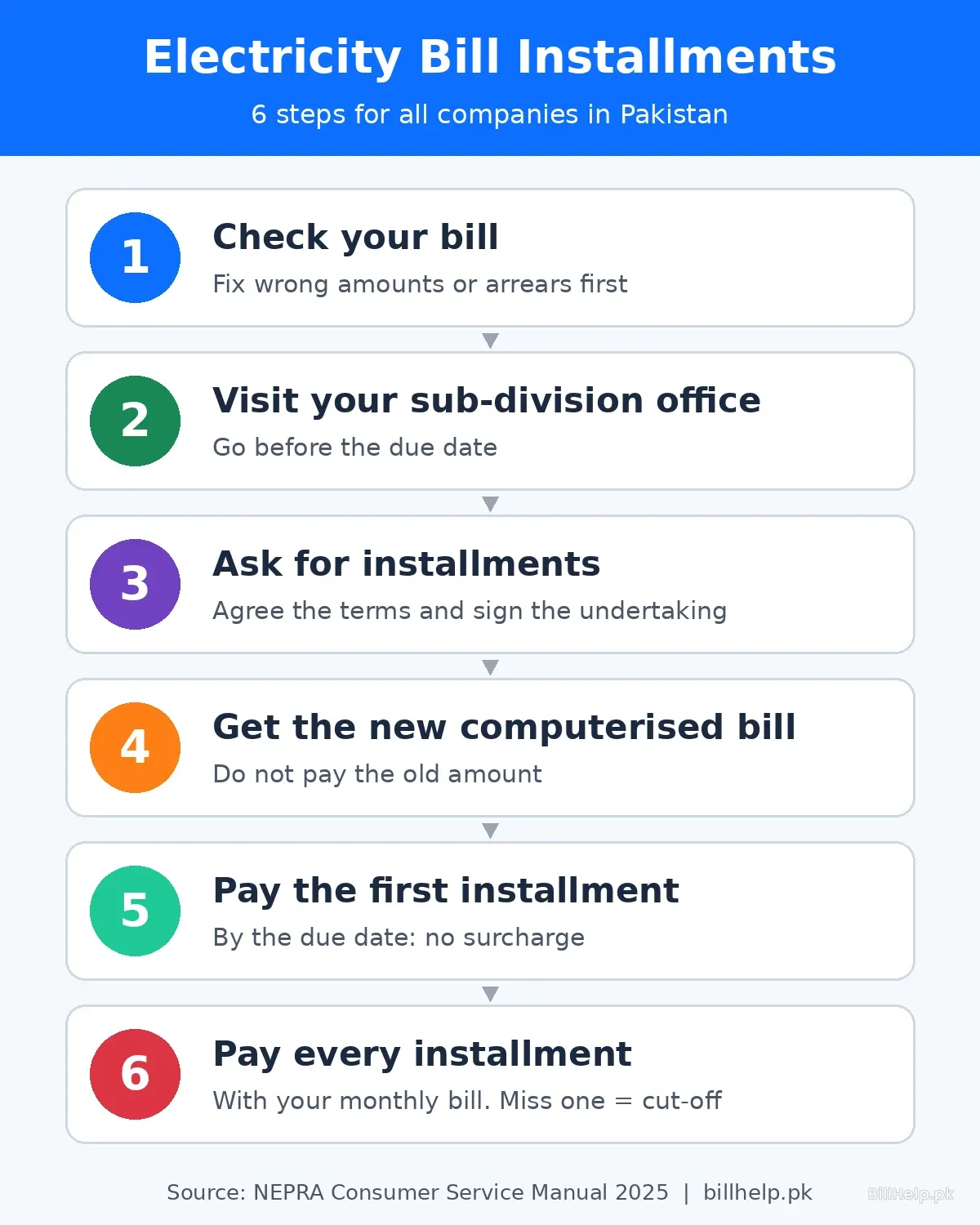
Short answer: Check the bill, go to your sub-division office before the due date, agree the plan, then pay each part on time.
- Check the bill first. Open your latest bill on your company's page on BillHelp. If the amount or arrears look wrong, get it corrected first. Splitting a wrong bill only spreads the mistake.
- Go to your local office before the due date. For most companies this is the sub-division office, run by the SDO. Your sub-division is printed on the bill.
- Ask for installments and agree the terms. Say whether it is the current bill or old dues. For arrears, IESCO and LESCO ask you to sign a written undertaking.
- Get the new bill. CSM clause 6.8.4 says the company must issue computerised bills once installments are allowed. Do not pay against the old bill amount.
- Pay the first installment by the due date. This keeps it free of surcharge.
- Pay each later installment with your monthly bill. The installment amount is shown on the bill. NEPRA's bill contents list includes an "Installments" line for amounts allowed by the competent officer.
Who approves it?
Short answer: An officer of your company. The bigger the amount, the more senior the officer.
NEPRA's manual calls this person the "competent officer" but does not name one post for all companies. Two companies publish their own ladder for arrears on general connections in their FAQs:
| Who decides | What is confirmed | Source |
|---|---|---|
| All DISCOs and K-Electric | Installments "may" be given. First part by due date: no surcharge. Rest: 14% a year markup. New computerised bill must be issued. | NEPRA CSM 2025, cl. 6.8 |
| IESCO | For arrears: SDO, XEN and SE up to set limits; CEO up to 6 monthly installments. No default in the last 6 months. | IESCO FAQs |
| LESCO | Same ladder for arrears. Says installments are not given on the running bill. | LESCO FAQs |
| K-Electric | Elderly and differently abled residential customers can ask for a bill installment by calling 118. | K-Electric FAQs |
We could not find a published approval ladder for the other companies. If your company is not in the table, start at your sub-division office. The full officer limits for IESCO and LESCO are in our IESCO installments guide and LESCO installments guide.
How many installments can I get?
Short answer: It depends on your company and the officer. NEPRA does not set one number for bills.
Where a company publishes a limit, it is usually small. IESCO and LESCO both say six equal monthly installments is the most, and only their CEO can allow six. Lower officers can allow three or four.
One different case has a fixed range in the manual. If your load has grown past the sanctioned load and you ignore the notice, CSM clause 2.14 says the extra security deposit is recovered through bills in 3 to 6 installments. That is a deposit, not an unpaid bill.
What should I take to the office?
Short answer: Your latest bill, plus proof of any payments you dispute.
- Your latest bill, so the staff can find your account.
- Paid receipts, if the bill shows arrears you already paid.
- Your signature on the written undertaking, where the company asks for one.
- If you are already disconnected: IESCO and LESCO say the undertaking is on stamped paper, and a fresh security deposit is needed.
We have not listed any other papers. No official page we checked gives one national document list for bill installments, so ask the office what else it needs.
What happens if I miss an installment?
CSM clause 8.2.6 protects you while the plan runs. Your supply should not be disconnected as long as you keep paying the installments. But it also says that if you default again, the company can disconnect at once and restore supply only after receiving a minimum of 50% of the dues.
Two more points from IESCO and LESCO's terms: you must pay the installment bill together with each current bill, and you cannot ask again for installments on the same dues. Set a reminder a few days before each due date. Paying online makes this easier. See how to pay electricity bills online in Pakistan.
I am already disconnected. Can I still get installments?
Short answer: Yes. The manual allows reconnection after full payment or payment in installments allowed by the company.
Under CSM clause 8.2.4, a supply cut for non-payment is restored after full payment with surcharge, or after payment in installments that the company has allowed. If the meter has been removed (clause 8.2.5), supply returns only after all dues are paid, in full or in installments, and other formalities are done. For a company example, see LESCO reconnection after disconnection.
Remember: a connection is not cut for one missed bill (clause 8.2.3). A seven-day notice comes with the second month's bill (clause 8.2.2). Asking for installments early, before that point, is far easier.
Does this work for detection bills?
Short answer: NEPRA's installment clause does not single out detection bills. Check the bill is correct first.
A detection bill charges for past units the company says were not billed. Chapter 9 of the manual sets how it is worked out. If you think it is wrong, challenge it before you agree to pay it in parts. Our MEPCO detection bill guide and LESCO wrong bill correction guide explain how to do that.
How is K-Electric different?
Short answer: K-Electric follows the same NEPRA manual but uses its own offices and some extra options.
NEPRA's manual says K-Electric must adapt the office names to its own structure. So the "SDO" step becomes a K-Electric customer care centre. K-Electric's own FAQs confirm these points:
- 118 helpline: elderly and differently abled residential customers can get a bill installment or token bill by phone.
- Bank Alfalah credit card plan (Alfa BNPL): pay a KE bill of Rs 3,000 or more in 3, 6, 9 or 12 monthly parts. The card must be at least 3 months old. There is no markup, but a one-time processing fee of 8%, 13%, 19% or 24% applies, by tenure. This is a bank plan, not a KE installment.
- Card payments on the KE website or app cannot be used for partial or installment payments.
- Advance income tax applies to installments, K-Electric says.
For K-Electric's own steps, read our K-Electric bill installments guide.
Find your company
Open your latest bill and check the amount before you visit the office:
Frequently asked questions
Is there a national limit on how many installments I can get?
No. NEPRA's manual leaves the number to each company. IESCO and LESCO publish a maximum of six for arrears.
Do I pay markup on electricity bill installments?
For the current bill, not on the first part if paid by the due date. The remaining parts carry 14% a year, pro-rata, under CSM clause 6.8.2.
Can I apply for installments online?
For the DISCOs, the route we could confirm is your local sub-division office. K-Electric lets elderly and differently abled residential customers ask by phone on 118.
Will my electricity be cut while I am paying installments?
No, as long as you keep paying them. If you miss one, supply can be cut without notice and restored after at least 50% of the dues are paid.
Can I ask for an extra few days instead?
Yes. Companies may extend the due date, and no late payment surcharge applies when the due date is extended (CSM clause 6.8.1).
Sources: NEPRA Consumer Service Manual, revised 2025, clauses 2.14, 6.8, 8.2.2 to 8.2.6, the bill contents table and the K-Electric nomenclature note; IESCO FAQs; LESCO FAQs; K-Electric FAQs. Checked 23 October 2026.