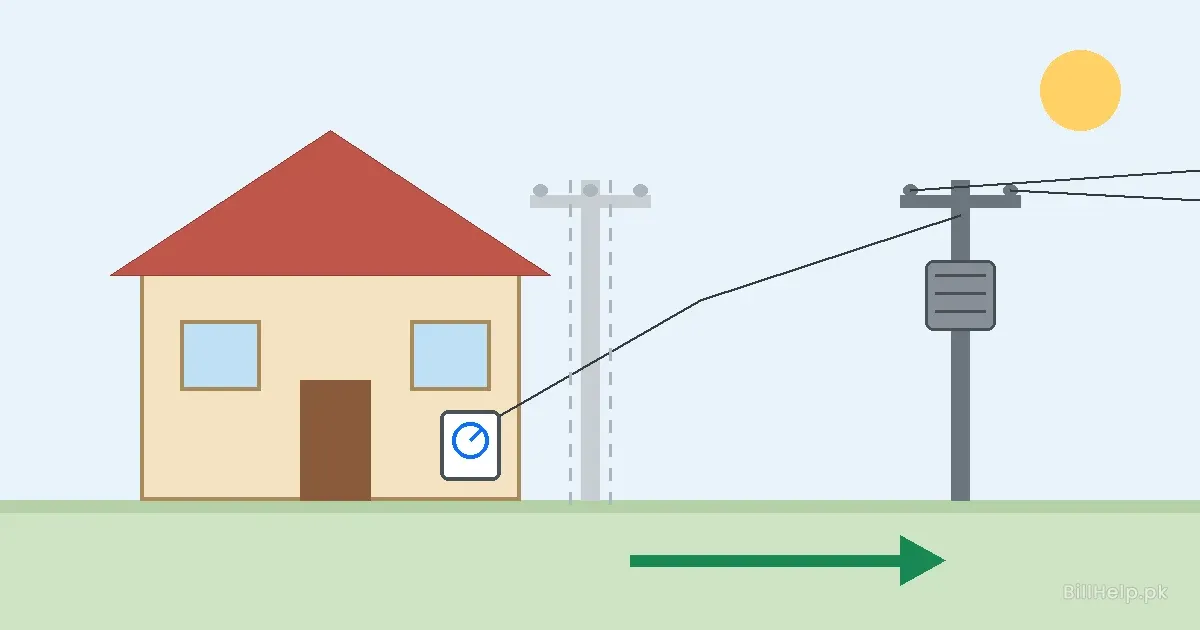
Want FESCO to move a pole, a wire, a transformer or your meter? Or are you moving house and want to take your connection with you? One question decides who pays: who asked for the change?
NEPRA's Consumer Service Manual (revised November 2025) sets the rules for FESCO and every other DISCO. This guide puts those rules in plain words for consumers in Faisalabad, Sargodha, Jhang, Toba Tek Singh, Chiniot, Mianwali, Khushab and Bhakkar.
You pay
You want a pole, line or transformer moved for your own convenience or building work. You want the meter moved. You are shifting the connection to a new site.
FESCO pays
FESCO built a line or other facility over your house or building without your consent, and you ask for it to be removed.
The project pays
The facility must move because of public works, such as road building or street widening. The sponsoring agency bears the cost.
If a pole, wire or transformer is in your way
Maybe you are building a boundary wall. Maybe a pole blocks your new gate. In this case FESCO will move the line, pole or transformer at your cost, if it finds the move feasible (clause 3.1.2).
Two more points matter:
- Right of way is your job. You must arrange the new route or spot. If the pole will stand on a neighbour's land, get the neighbour's agreement first.
- Building first does not change the rule. If you build a house, shop or building near or under an existing line and then ask for it to be moved, you still pay and you still arrange the right of way (clause 3.1.3).
FESCO sends the cost through a demand notice. The manual fixes how the bill is made up:
| Part of the demand notice | How it is worked out |
|---|---|
| Shifting and installation | 10% of the cost of the material being moved, at current rates |
| New or extra material | Full cost of any extra material needed at the new spot, plus 12% store handling charges |
| Installing the extra material | 8% of the cost of the new or extra material |
So a short move that reuses the same pole and wire costs far less than a move that needs a new pole or a longer cable. Ask the SDO's staff to show you the material list before you pay. During a move, FESCO may also change an overhead line to an underground cable, or the other way round, to suit the site (clause 3.1.5).
If FESCO put it on your house without asking
This is the one case where you should not pay. Clause 3.1.4 says a DISCO cannot build any distribution facility over a house or building without the owner's consent. If it does, it must move the facility at its own cost when the owner asks.
- Write to your FESCO SDO. Say what was built, where, and roughly when.
- State clearly that you never gave consent. Quote clause 3.1.4 of the Consumer Service Manual.
- Attach photos and proof that you own the property.
- Keep a stamped receipt copy of your letter. You will need it if you have to complain to NEPRA.
Do not try to move or cut a live line yourself. Ever.
If only your meter needs a new spot
Moving a meter on the same property is the cheapest change. Clause 4.2.8 sets out the steps:
- Apply to FESCO in person or online, and give your reason.
- FESCO surveys the new place within seven days.
- If it agrees, it issues a demand notice: Rs 500 for a single-phase meter or Rs 1,000 for a three-phase meter, plus any extra material.
- After you pay, FESCO shifts the meter.
Pick the new spot with the rules in mind. The meter should be outside the premises, in a safe and reachable place (clause 4.2.1). It should also be at a height where the meter reader can read it without climbing. If the meter is on your wall, its safe custody is your responsibility. If FESCO fixes it on its own pole, FESCO is responsible.
Note that FESCO can also move a meter on its own to meet tariff or code rules (clause 4.2.4). It does not need your request for that.
If you are moving to a new house or plot
You can shift an existing connection to a new site inside FESCO's area. This works for domestic and commercial (A1, A2), general services (A3), industrial and agricultural connections (clause 2.12.1). The new site must be in your name, your legal heir's name, or held on a proper lease. If it is in an heir's name, FESCO processes a change of name too.
Papers to attach to the application form
- Ownership proof for both the old site and the new site
- A wiring test report from the Electric Inspector or his authorised wiring contractor
- Your last paid bill, with no arrears, deferred amount or installments pending
- Attested copy of your CNIC
The charges follow the same 10% / 12% / 8% formula shown above. You also pay the security deposit at current rates, minus what you already paid. All dues must be clear. Finally, the transformer and feeder at the new site must be able to take your load.
Who approves it? Usually the same officer who sanctions new connections, if the new site is in their area. If you move from one FESCO circle to another, for example from Faisalabad to Sargodha, the GM (Technical) can approve it for loads up to 500 kW.
If FESCO refuses or sits on your request
NEPRA does step in. Two real FESCO cases show how:
A Sargodha consumer had paid for six tubewell connections, with transformers and an HT line, on a cost deposit basis. He lost the land lease in Chiniot district. NEPRA ordered FESCO to shift his connections, with all the material he had paid for, to sites of his choice, following the normal formalities (Complaint FESCO-64/05/2018).
A Chiniot consumer's 50 kVA transformer was installed for five farm connections. Other connections were later added to it, and it was damaged many times. NEPRA told FESCO to move the extra connections to a separate common transformer at FESCO's own cost. The complainant agreed to pay for a reclaimed 50 kVA transformer (Complaint FESCO-NHQ-18472-12-22).
The lesson: keep your demand notices and paid receipts. They prove what you paid for.
If FESCO does not act on your written request, file a complaint on NEPRA's Complaint Management System. Attach your letter, receipts and photos. If your problem is a wrong bill or a meter test, the route is different: see our FESCO Electric Inspector (POI) guide.
Quick checks
| Can FESCO refuse to move a pole I asked to move? | Yes. The manual says FESCO will move it "if found feasible". Ask for the reason in writing if it says no. |
|---|---|
| How much does it cost to move a single-phase meter on the same property? | Rs 500 shifting charges, plus the cost of any extra material, through a demand notice. |
| Can I take my connection to another district? | Yes, if the new site is inside FESCO's area and meets the new-connection rules. Connection shifting only works inside FESCO's area. Moving equipment to another company's area has separate rules (clause 2.16). |
| Do I need a new test report when shifting? | Yes. A wiring test report from the Electric Inspector or his authorised contractor is on the document list. |
Sources: NEPRA Consumer Service Manual, revised 26 November 2025 (clauses 2.12, 3.1, 4.2, 8.3); NEPRA Authority decisions on FESCO complaints (FESCO-64/05/2018; FESCO-NHQ-18472-12-22). Checked 23 October 2026.