Legislative Background & Historical Context
The passing of the Punjab Suthra Authority Act by the Provincial Assembly of Punjab is a change in how cities are run how public health is handled and how the environment is managed in Pakistans largest province. Before this law was created cleaning services in cities were spread out among different groups like municipal corporations, district councils, town committees and local waste management groups. This way of working made things hard led to service, not enough money and a lot of damage to the environment, in both cities and rural areas.
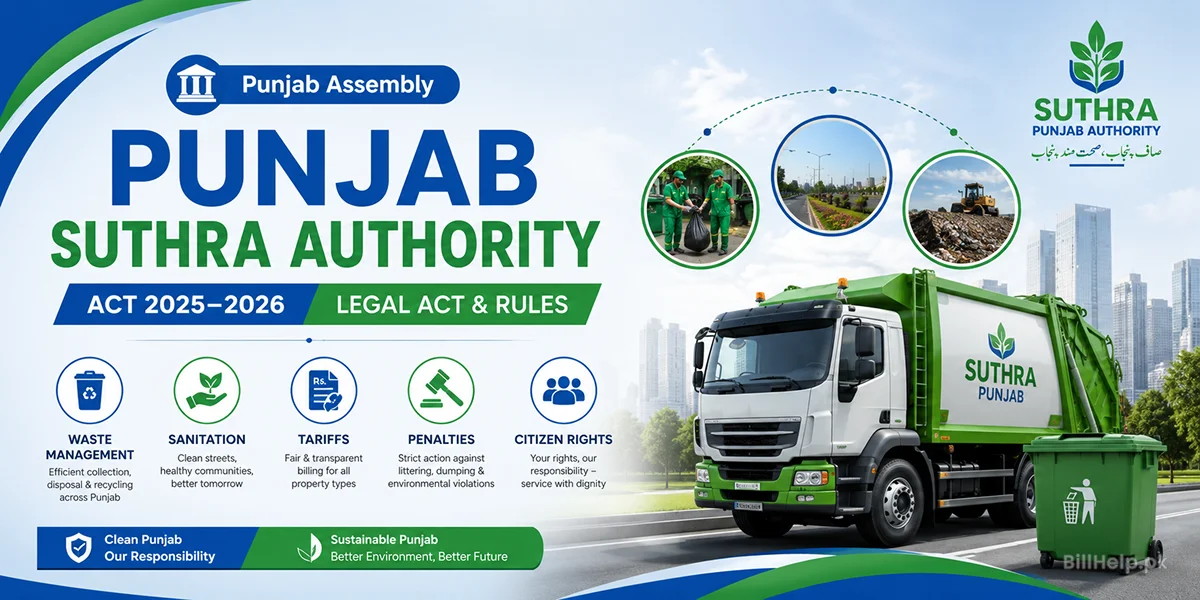
The Chief Minister and Provincial Cabinet tabled the Suthra Punjab Bill for a single autonomous statutory body with full regulatory, administrative and fiscal powers, taking cognizance of the critical need for institutional consolidation. The Act officially cancels redundant municipal by-laws and places solid waste management functions under the umbrella of the Punjab Suthra Authority (popularly called the Suthra Punjab Cleanliness Authority).
The four main legislative purposes of this statute are:
- Universal Service Coverage: Extending waste collection, street cleaning and drain maintenance services from big cities to rural union councils and the edges of urban areas.
- Financial Sustainability: Creating a legal system for sanitation taxes and user fees to support modern equipment, landfill projects and recycling systems reducing dependence, on unstable provincial funding.
- Environmental Compliance: Applying laws to stop dangerous industrial waste dumping illegal open burning, farm waste fires and pollution of municipal water channels.
- Public-Private Integration: Setting up a legal framework to allow trusted local and foreign waste management companies to operate in designated zones while ensuring public health remains protected.
2. Statutory Mandate and Institutional Governance
The new body, established under the provisions of the Suthra Authority Act, is a body corporate with perpetual succession, common seal and statutory capacity to sue and be sued, acquire property, enter into public-private partnerships and formulate binding municipal regulations.
Clause A: Central Administrative Body & Executive Directorate
The Authority is headed by a Board of Directors comprising of Minister for Local Government and Community Development (LG&CD) with representation from Finance Department, Environment Protection Department, Excise & Taxation Department and independent experts in urban planning. The executive management is led by a Director General appointed by the Provincial Government who is responsible for operationalizing the extraction of waste, management of transfer stations and collection of billing across all the 36 districts of the Punjab.
Clause B: Basic Operational Mandates
The Act expressly provides for mandatory statutory duties to be performed by the Authority such as door-to-door collection of solid waste from the residential buildings, commercial establishments, institutions and industrial parks. It requires the construction of engineered sanitary landfills, material recovery facilities (MRFs), waste-to-energy conversion plants and neighborhood transfer stations to eliminate open garbage dumps (Kurra Karkat depots).
Clause C: Decentralization to District & Municipal Level Units
Policy framing and tariff setting are centralized but the operational execution is organized up to the District Suthra Offices headed by District Municipal Officers. At the grassroots level, Union Council Sanitation Committees are empowered to oversee daily collection schedules, supervise sanitary staff, and report service gaps directly to the central digital monitoring dashboard.
3. Tariff Design, Billing Structure and Assessment Rules
The Act also provides for the legal establishment of a regime of taxation for municipal sanitation charges. The law gives the Provincial Government the power to establish tariff schedules according to people’s income level. This makes the charges affordable for low‑income households and fair for properties and commercial businesses.
| Property Classification | Unit Size / Covered Area Criteria | Location Tier | Statutory Monthly Tariff Range (PKR) | Assessment Basis |
|---|---|---|---|---|
| Residential - Tier 1 | Up to 5 Marla | Rural Union Councils & Small Towns | Rs. 100 – Rs. 200 | Flat Monthly Municipal Assessment |
| Residential - Tier 2 | 5 Marla to 10 Marla | Urban Municipalities & Cantonments | Rs. 300 – Rs. 500 | Property Tax Rating List Category |
| Residential - Tier 3 | 10 Marla to 1 Kanal | Metropolitan Cities (Lahore, FSD, RWP) | Rs. 500 – Rs. 1,000 | Covered Area & Rental Value Scale |
| Residential - Tier 4 | Above 1 Kanal / Luxury Estates | Prime Residential & Gated Societies | Rs. 1,000 – Rs. 2,500 | Luxury Municipal Assessment Zone |
| Commercial - Retail | Small Shops, Kiosks & Retail Outlets | Commercial Bazaars & Markets | Rs. 500 – Rs. 1,500 | Trade License & Location Classification |
| Commercial - Large | Shopping Malls, Hotels & Plazas | Main Arterial & Commercial Roads | Rs. 2,500 – Rs. 10,000 | Floor Space & Waste Volume Assessment |
| Industrial & Healthcare | Factories, Mills, Hospitals & Clinics | Industrial Estates & Special Zones | Custom Assessment / Volume Tariff | Special Hazardous Waste Handling Schedule |
Billing schedules are issued on a monthly, quarterly, or bi-annual basis depending on the district administration. The billing rules require each bill to include a PSID code that works with the ePay system. This lets citizens pay using banking, mobile wallets or, at authorized bank branches.
4. Coordination with Excise, Taxation & Local Government Departments
Section 18 of the Suthra Authority Act mandates full technical and operational interoperability between the Suthra Punjab Authority, Punjab Excise, Taxation & Narcotics Control Department and local municipal corporations to eliminate duplicate bureaucratic costs and maximize revenue recovery.
Major institutional synergies are:
- Unified Property Assessment Database: Sanitation tariff will be mapped directly to the existing Excise Department Property Tax PIN numbers (PTIN) This guaranties that all registered urban property is issued an integrated or cross-referenced sanitation bill.
- Joint Recovery & Demand Notices: In cases of chronic non-payment of sanitation dues, Excise Officer or Municipal Collector can issue combined demand notices along with annual urban property tax assessment.
- Treasury Deposit: I notice that all money that comes from sanitation bills, commercial waste tipping fees and littering fines goes straight into the Punjab Treasury Account heads (Account No. 1). This step ensures that money is handled transparently and stops any attempt by bodies to divert funds.
- Inter-Agency Data Sharing: I notice that Water and Sanitation Agencies (WASA) Development Authorities such as LDA, FDA, RDA and local electricity distribution companies (DISCOs) must legally share property consumer data. Sharing these bills makes the bills accurate. It ensures that the coverage is complete.
5. Environmental Offenses, Penalties & Summary Enforcement
I notice that the Punjab Assembly added penalties inside the Suthra Authority Act to stop people from littering illegal waste dumping and businesses, from breaking rules. Chapter V of the Act gives inspectors and Suthra Enforcement Squads quick legal powers. These inspectors and squads can issue notices check places and impose spot fines away.
Minor & Small Crimes
- Littering in Public Spaces: I have seen people throwing household garbage, plastic bottles or debris on roads, parks or open plots and Littering in Public Spaces will immediately attract a fine of Rs. 500 To Rs. 2,000.
- Uncovered Commercial Waste: Market vendors and shopkeepers not covering their waste bins outside their shops may have to cough up Rs. 1,000 To Rs. 5,000.
- Drain Blockage & Liquid Dumping: I have seen people dumping construction slurry, grease or solid refuse, into drainage networks. Drain Blockage & Liquid Dumping will carry fines up to Rs. 10,000.
Major and Commercial Crimes
- Illegal Industrial Tipping: I have seen companies dumping chemical sludge, industrial effluent or non-biodegradable waste in unapproved places and Illegal Industrial Tipping can attract penalties ranging from Rs. 50,000 To Rs. 500,000 And may lead to sealing of the factory.
- Hospital Waste Violations: Throwing untreated waste from a hospital or clinic into city garbage is illegal. It can lead to up to one year in prison and fines as set by the Environmental Protection Act together with the Suthra Act.
- Persistent Default: If you do not pay sanitation bills for, over six billing periods the property may be. The unpaid amounts may be collected as land revenue arrears.
6. Legal Rights, Appeals and Dispute Resolution
I believe the Suthra Authority Act gives people and business owners rights. I believe the Suthra Authority Act helps people challenge government actions fix bills and correct mistakes, in property classifications. If there is a dispute the law provides a way to appeal and resolve problems fairly.
Tier 1: District Assessment Review Committee (DARC)
Any property owner who is aggrieved by a wrong bill tariff, wrong covered area measurement, duplicate billing notice or failure of service delivery may file a formal petition before the District Assessment Review Committee within 30 days of receipt of the bill. The DARC headed by an Additional Deputy Commissioner (Revenue) shall hear the applicant and decide the matter within 15 working days.
Tier 2: Provincial Appellate Tribunal
If any citizen or corporate entity is not satisfied with the order of the DARC, he may file a second appeal before the Suthra Appellate Tribunal headed by a retired District Judge or Senior Legal Officer of the LG&CD Department. The decision of the Appellate Tribunal shall be final on questions of fact, save and except the constitutional writ jurisdiction of the Honorable Lahore High Court under Article 199.
Apart from the formal committees of appeals, citizens can also register their grievances related to services like missed garbage collection or not cleaning of street drains on the Chief Minister’s Helpline (1190) or the official Suthra Punjab Citizen App for quick redress within 24 hours.
7. Rights, duties and statutory obligations of property owners
The Suthra Punjab Act envisages an equitable system of mutual legal rights and responsibilities that would be binding on both the public authority and private citizens. Knowing these legal rights and responsibilities helps one to live in a peaceful municipality and also saves the property owners from excessive penalties.
Statutory Rights of Citizens
- To Regular Collection: People who own property and pay their sanitation fees have a right to ask for regular waste collection and cleaning of streets.
- Right to Transparent Billing: Citizens should get bills that show how the charges are calculated when they are due and how to pay.
- Right to Redressal: People can file complaints about missing workers, full waste bins or mistakes in bills.
- Right to Receipts: Every time someone pays through methods or, at a bank counter they get a legal receipt. This receipt proves that the payment was made and can be used to stop any notices.
Statutory Duties of Citizens
- Duty of Source Segregation: People who live in a property must separate their waste into items that can be recycled wet waste that can be composted and dangerous materials before giving it to the workers.
- Duty of Timely Payment: The assessed sanitation fees must be paid by the property owners by the due date shown on the billing statement.
- Mandatory use of designated bins: Commercial operators must set up covered bins outside their premises. Shall not litter waste on footpaths or road shoulders.
- Duty to Prevent Nuisance: Citizens shall prevent the collection of water, green waste debris or unmanaged construction materials, on public thoroughfares.