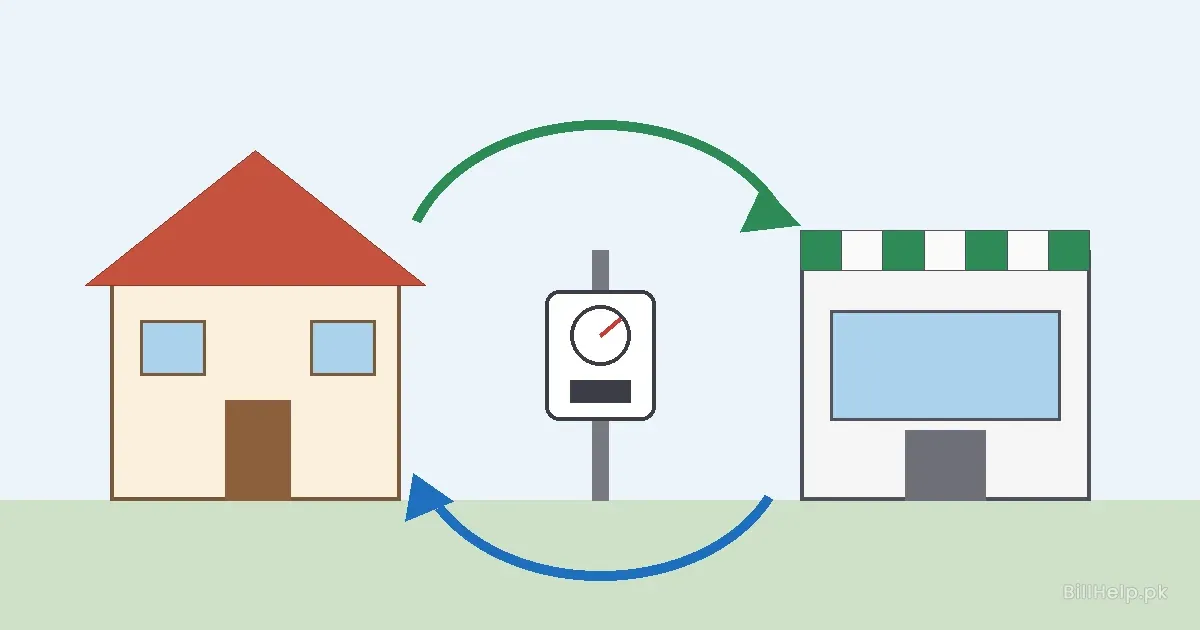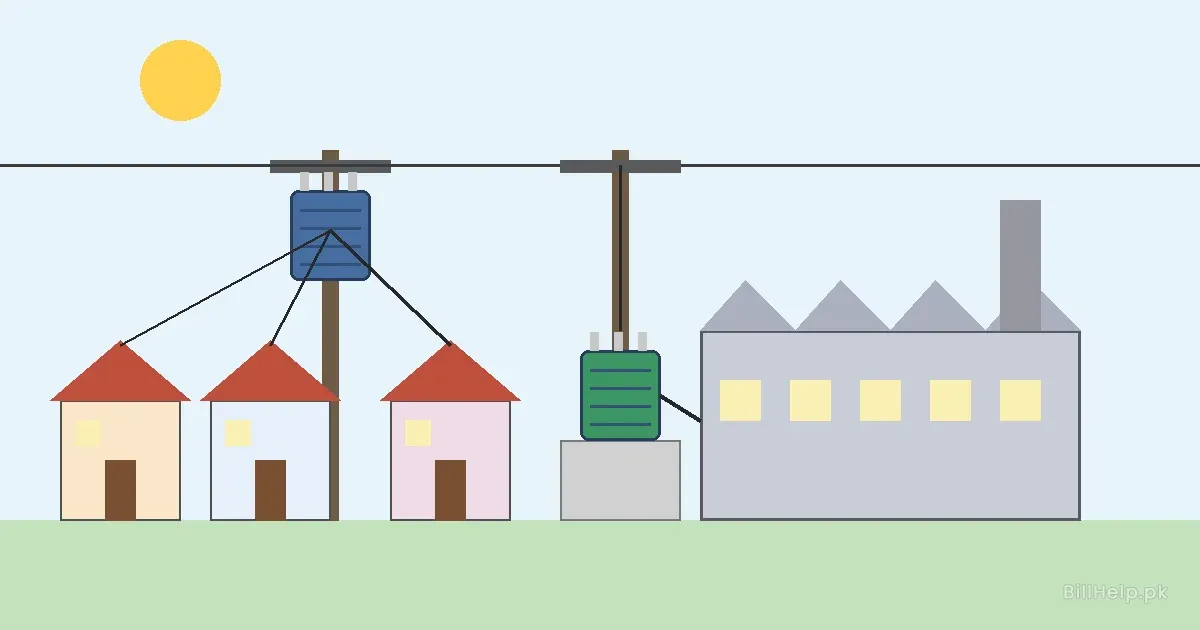
20 kW. For a house in the FESCO area, that one number decides whether you share a transformer with your street or need one of your own. For a shop the line is 15 kW. For a tubewell or a small factory it is only 8 kW.
A common transformer belongs to FESCO and feeds many homes and shops. A dedicated transformer serves one consumer or one building, and the consumer usually pays for it. This guide explains where the lines fall, what "sharing charges" are, who repairs a transformer when it burns, and what happens to your transformer when you no longer need it. Every rule comes from the NEPRA Consumer Service Manual (revised 26 November 2025). FESCO must follow it across all eight of its districts, from Faisalabad and Chiniot to Sargodha and Bhakkar.
Thresholds
Clause 2.6 of the manual sets the load at which you leave the shared transformer. These limits are for individual connections. Housing societies, plazas and multi-storey buildings have separate rules in the same clause.
| Connection type | Common transformer | Dedicated transformer or sharing charges | Dedicated transformer only |
|---|---|---|---|
| Home (A-1) | Up to 20 kW | Above 20 kW to 100 kW | Above 100 kW |
| Shop, office (A-2) or general services (A-3) | Up to 15 kW | Above 15 kW to 100 kW | Above 100 kW |
| Industry | Up to 8 kW | Above 8 kW to 25 kW | Above 25 kW |
| Agriculture (tubewell) | Up to 8 kW | No sharing option | Above 8 kW |
| Temporary supply | Up to 20 kW, if available | No sharing option | Above 20 kW |
For larger shops, offices and factories, FESCO can also add "rehabilitation charges" when the connection is fed straight from an 11 kV distribution feeder.
Sharing
In the middle band, you do not always need a new transformer. FESCO can connect you to one that already exists and charge you a share of its cost instead. The manual sets three conditions for this (notes iv and i under clause 2.6):
- Spare capacity. The existing transformer must have room for your load.
- Your share only. Sharing charges are worked out in proportion to your load.
- Consent. Both sides must agree. If the transformer is someone else's dedicated system, you need a no objection certificate (NOC) from its owner, and the connection must be technically feasible.
There is a catch with the last point. Once you join someone's dedicated system, the whole group pays for its repair and upgrade later, each in proportion to their load, on a cost deposit basis.
Two more notes in the same clause matter in villages and new areas:
- Where no common system exists, FESCO gives the connection on a cost deposit basis. If FESCO later turns that system into a common one, it must pay the owner back for the transformer and LT line. The HT line is not refunded.
- If you are entitled to the common transformer but still want your own, you can have one. You pay its full cost.
For factories with more than one connection on the same premises, clause 2.8.1 adds a rule. A connection above 8 kW gets its own transformer. If your existing dedicated transformer has spare capacity, the extra connection goes on it. If not, FESCO adds a transformer or raises the capacity of the old one, at your cost.
Space
A dedicated transformer needs a place to sit. Under clause 2.9, if you need up to 630 kVA you do not have to build a substation. You still have to give a safe space and a right of way for the transformer. If FESCO took space from you and you later close the connection for good, you can ask for that space back. The exception: if FESCO turned the transformer into a common one with your consent and now feeds other people from it, the space stays with FESCO.
Breakdowns
Who fixes a burnt or stolen transformer depends on who owns it.
A distribution substation is owned and maintained by FESCO for general use. If it is damaged or stolen, clause 11.2 makes installing another one FESCO's responsibility.
A consumer substation is owned and maintained by the consumer (clause 11.3). FESCO's duty stops at the metering point. For your own maintenance, FESCO will shut the supply without charge if you ask in writing three days ahead.
A dedicated system shared under an NOC is repaired by all the connected consumers, each paying for their share of the load (note i, clause 2.6).
When a common transformer fails, the whole street loses power. Report it to FESCO on 118 as a collective complaint. Clause 10.4 of the manual lists damaged transformers as a collective complaint. Only current leakage gets higher priority. While the damaged unit is being replaced, FESCO is supposed to restore supply through a trolley-mounted or other spare transformer. It should also try to feed homes from another source. Where its own workshops cannot repair transformers quickly, FESCO may use approved private vendors.
Leftovers
Maybe you cut your load, closed the factory or moved. What happens to the transformer you paid for?
It is valued at a depreciated price. Section 8.5 of the manual gives a transformer a 20-year life. Its value drops by 5% a year, but never below 20% of the first cost. So a transformer that has run for 8 years is valued at 60% of its first cost. One that is 16 years or older stays at the 20% floor.
You can move it to another connection of yours. Clause 8.5.8 lets you install a redundant transformer at another connection in your own name. You pay testing and installation charges.
You cannot sell it to a neighbour on your own. A real Faisalabad case shows why.
NEPRA decision of 10 February 2022 (FESCO-NHQ-01-01-2022)
A textile mill near Khurrianwala moved its supply to another grid station through a new independent 11 kV feeder, so its old feeder sat idle. A second mill needed an independent feeder to raise its load from 450 kW to 2,500 kW. The two mills agreed a price between themselves, and FESCO asked NEPRA for advice.
NEPRA said the first mill could not hand the line over on its own, and such a private deal was illegal. Under the Consumer Eligibility Criteria 2003, FESCO keeps the spare system and pays the original owner its depreciated value, at 5% a year from the date it was energised. FESCO could recover the capital cost from the new user at new rates, but not installation, dismantling or consultancy charges, and it had to maintain the feeder at its own cost for two years.
The rule works the same way for a smaller dedicated transformer. If a neighbour wants to use yours, the route is through FESCO, not a private sale.
Disputes
Keep every demand notice and paid receipt. They are your proof of what you paid for and who owns the equipment. If FESCO asks you to pay for a common transformer, refuses a fair sharing request, or does not compensate you for a system it keeps, complain in writing to your FESCO office first. If that fails, file with NEPRA's online complaint system. NEPRA has ruled on transformer cases against FESCO before. One is in our FESCO shifting guide, where extra connections on an overloaded farm transformer were moved off it at FESCO's cost.
Questions
Sources: NEPRA Consumer Service Manual, revised 2025 (clauses 2.6, 2.8.1, 2.9, 8.5, 8.5.8, 10.4, 11.2, 11.3); NEPRA decision on FESCO's idle 11 kV feeder, February 2022, listed on NEPRA's FESCO decisions page.